Bodu.Globalization.Calendar.Caching Namespace
- Packages
Purpose
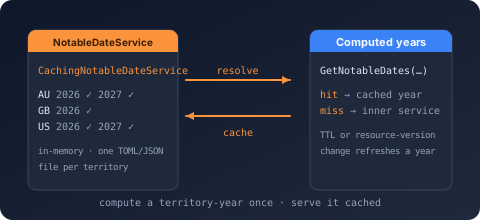
Bodu.Globalization.Calendar.Caching is the read-through caching layer for the
Bodu.Globalization.Calendar notable-date engine. Rather than building caching into
the engine, it ships CachingNotableDateService, a decorator that implements
the same INotableDateService contract and serves each requested civil year from an
INotableDateCache, recomputing a year through the wrapped service only on a
miss. Consumers hold the same interface either way; only when a year is computed changes.
The cache unit is one territory's occurrences for one whole civil year. A range is decomposed into the years it spans, each year is served from the cache when a fresh, version-matching entry exists, and the assembled occurrences are clipped to the requested window. Freshness has two independent triggers the cache evaluates on every call: a time-to-live (default 30 days, with optional deterministic jitter and access-triggered refresh-ahead), and a resource-version token that invalidates every year computed under a previous resource - derived automatically from an observed INotableDateResourceProvider, so a reload forces a recompute regardless of the time-to-live. Concurrent cold misses for the same year coalesce onto one computation.
The core package ships the in-memory and per-territory TOML / JSON file backends; two add-on packages supply durable,
shareable storage over the same contract and namespace - Bodu.Globalization.Calendar.Caching.Sqlite
(SqliteNotableDateCache) and
Bodu.Globalization.Calendar.Caching.Distributed (DistributedNotableDateCache
over any IDistributedCache, Redis included). Every backend applies the same freshness, validity, version-matching,
merge, and ordering rules, and every backend is best-effort by default: a storage fault surfaces as an empty read or a
skipped write, never as an exception that breaks date resolution.
All dependency-injection registration lives in the Bodu.Globalization.Calendar namespace, so a single
using Bodu.Globalization.Calendar; makes AddCachedNotableDateService, AddSqliteNotableDateCache,
AddDistributedNotableDateCache, AddRedisNotableDateCache, and AddNotableDateCacheWarmup available. There are no
separate *.DependencyInjection packages.
Static documentation
- Introduction - the package family and which backend to pick, the decorator, the cache unit and freshness model, the storage contract, headline types, and the DI registrations.
- Core concepts - decorator vs service, cache key and unit, hit / miss / coalesced flight / refresh-ahead, time-to-live vs resource version, warm-up, write status, storage failure policy, backend classes, observability, thread safety and lifetime.
- Getting started - install and minimal samples: in-memory, TOML file, DI with
appsettings.json, SQLite, Redis, warm-up, and a customINotableDateCache. - Caching notable dates guide - worked patterns, freshness tuning, observability, and troubleshooting.
- Calendar dependency injection guide - the
AddNotableDateService/AddReloadableNotableDateServiceregistrations the decorator wraps.
Key types
Service and decorator
- CachingNotableDateService - the decorator. Constructed over an inner
INotableDateService, anINotableDateCache, and aNotableDateCachingOptions, with an optionalINotableDateResourceProviderversion source,TimeProvider,ILoggerFactory, andownsCacheflag. Implements everyINotableDateServicemember (the filtered overloads apply the filter after assembly; discovery methods delegate) and addsWarm(territories, firstYear, lastYear). Disposable; disposes the cache only when it owns it.
Contract
- INotableDateCache - the storage contract:
GetYear(territory, year, resourceVersion, ttl, asOf)returns a fresh, version-matching entry ornull;StoreYear(entry, ttl, asOf)merges a computed year, prunes stale and superseded-version entries, and reports a write status;Clear()empties the cache best-effort. Implementations preserve occurrence order and degrade rather than throw on storage faults. - NotableDateCacheEntry - the cache unit:
Territory,Year,ResourceVersion, the orderedOccurrences,ComputedAtUtc, andIsFresh(asOf, ttl). An empty occurrence list is a valid, cacheable result. - NotableDateCacheWriteStatus -
Stored(persisted),Skipped(a deliberate no-op cache),Failed(a swallowed storage error; nothing persisted).
Options
- NotableDateCachingOptions - the decorator's options:
Ttl(30 days),TtlJitterandRefreshAheadFraction(both0, range[0, 1)),ResourceVersion(the fixed token used when no provider is observed),CacheDirectory(for the default file cache),CacheHitLogLevel/CacheMissLogLevel(Information);Validate()throws,TryValidate(out error)backsValidateOnStart. - NotableDateCacheOptions - the storage-agnostic base of every backend's options:
ThrowOnStorageFailure(rethrowIOException/UnauthorizedAccessExceptioninstead of degrading) andValidateStorageOnStart(probe the store at construction or host start), bothfalseby default; virtualValidate()/TryValidate(out error). - FileNotableDateCacheOptions - adds
CacheDirectory(null→bodu-notable-datesunder the system temporary path). - SqliteNotableDateCacheOptions -
DatabaseFilePathor a fullConnectionString(precedence; at least one required),UseWriteAheadLogging(true),BusyTimeout(five seconds). - DistributedNotableDateCacheOptions -
KeyPrefix(keys are<prefix>notable-dates:<TERRITORY>) andEntryExpirationMargin(one hour, added to the time-to-live as each blob's server-side absolute expiration;nulldisables it). - NotableDateCacheWarmupOptions - the startup warm-up:
Territories, a rollingYearsBehind(0) /YearsAhead(1) window around the current UTC year, or pinnedFirstYear/LastYear.
Backends
- NotableDateCacheBase<TOptions> - the storage-agnostic mechanism behind every shipped backend: territory normalization, read-time freshness and version filtering, and write-time merge-and-prune under a per-territory lock, over a
protected internalReadEntries/WriteEntriesseam opened to the companion packages. A third-party store implementsINotableDateCachedirectly. - FileNotableDateCacheBase - the file mechanism: one file per territory under
CacheDirectory, atomic temp-and-move writes, a last-write-time parse memo, rate-limited degradation warnings. - InMemoryNotableDateCache - process memory; nothing persisted.
- TomlNotableDateCache, JsonNotableDateCache - one
<TERRITORY>.toml/.jsonfile per territory; malformed content reads as empty and is repaired by the next write. - SqliteNotableDateCache - a
notable_datestable keyed by(territory, year, version)with a single-rowGetYearoverride and a keep-alive connection; disposable. Registered withAddSqliteNotableDateCache. - DistributedNotableDateCache - one JSON blob per territory in any
IDistributedCache, stamped with a server-side expiration;Clearremoves only the keys the instance wrote. Registered withAddDistributedNotableDateCacheor the Redis convenienceAddRedisNotableDateCache. - NullNotableDateCache - the no-op cache (
NullNotableDateCache.Instance), for when caching is disabled.
Dependency injection and warm-up (namespace Bodu.Globalization.Calendar)
- NotableDateCachingExtensions -
AddCachedNotableDateService(configure?, cacheFactory?)andAddCachedNotableDateService(configuration, sectionName = "Calendar:NotableDateCache", configure?, cacheFactory?): decorates the registeredINotableDateServicein place (the previous registration becomes the inner service), builds and owns aTomlNotableDateCachewhen nocacheFactoryis supplied, observes a registeredINotableDateResourceProvider,TimeProvider, andILoggerFactory, and validates the options at host start. ThrowsInvalidOperationExceptionwhen no service is registered. - SqliteNotableDateCacheExtensions -
AddSqliteNotableDateCache(configuration?, sectionName = "Calendar:NotableDateCache:Sqlite", configure?): a singletonSqliteNotableDateCachealso exposed asINotableDateCache, with the storage probe wired intoValidateOnStartwhenValidateStorageOnStartis set. - DistributedNotableDateCacheExtensions -
AddDistributedNotableDateCache(configuration?, sectionName = "Calendar:NotableDateCache:Distributed", configure?)over the container'sIDistributedCache, andAddRedisNotableDateCache(configureRedis, configuration?, sectionName, configure?), which registers the Redis cache first. - NotableDateCacheWarmupExtensions -
AddNotableDateCacheWarmup(configuration?, sectionName = "Calendar:NotableDateCacheWarmup", configure?): a hosted service that warms the configured territories after the host starts without blocking it; no-ops with a warning when the registered service is not the caching decorator.
On-disk schema
- NotableDateCacheFile - the document the file caches and the distributed blob serialize:
Territory, anEntriesarray, and a flatOccurrencesarray. - NotableDateCacheYearRow - one row per cached year:
Year,Version,ComputedAtUtc; present even for a year with no occurrences. - NotableDateCacheOccurrenceRow - one flat scalar row per occurrence, carrying its
YearandVersionplus every NotableDate field, with the rule identity flattened toResourceId/NotableDateId/RuleIdand the category as its enum name. The SQLite backend stores the same rows as a JSON blob per year.
Example
using Bodu.Globalization.Calendar;
using Bodu.Globalization.Calendar.Caching;

// Wrap any INotableDateService - here a regional data pack - in the decorator over a per-territory TOML cache.
INotableDateService engine = AmericasCalendarData.CreateService("US");

using var calendar = new CachingNotableDateService(
    engine,
    new TomlNotableDateCache(new FileNotableDateCacheOptions { CacheDirectory = "/var/cache/notable-dates" }),
    new NotableDateCachingOptions
    {
        Ttl = TimeSpan.FromDays(30),
        RefreshAheadFraction = 0.75,               // recompute a hot year in the background after 75% of the TTL
        ResourceVersion = "us-holidays-2026.1",    // bump after a data update; a resource provider derives this automatically
    },
    ownsCache: true);

// The first query computes and caches all of 2026; the next two are cache hits.
IReadOnlyList<NotableDate> year = calendar.Resolve(2026, "US");
IReadOnlyList<NotableDate> day = calendar.Resolve(new DateOnly(2026, 7, 4), "US");
IReadOnlyList<NotableDate> closures = calendar.Resolve(2026, "US-CA", NotableDateFilter.IsNonWorkingDay());

// Pre-pay the computations for next year as well.
int warmed = calendar.Warm(new[] { "US", "US-CA" }, 2026, 2027);
Under dependency injection, register the service first and decorate it in place; add the durable backends through their
own registrations and hand them to the decorator through cacheFactory:
using Bodu.Globalization.Calendar;
using Bodu.Globalization.Calendar.Caching;
using Microsoft.Extensions.DependencyInjection;

builder.Services.AddReloadableNotableDateService(AmericasCalendarData.LoadResource("US"));
builder.Services.AddSqliteNotableDateCache(builder.Configuration);           // Calendar:NotableDateCache:Sqlite
builder.Services.AddCachedNotableDateService(
    builder.Configuration,                                                    // Calendar:NotableDateCache
    cacheFactory: sp => sp.GetRequiredService<INotableDateCache>());
builder.Services.AddNotableDateCacheWarmup(builder.Configuration);           // Calendar:NotableDateCacheWarmup
Notes
- Order matters under DI.
AddCachedNotableDateServicedecorates whateverINotableDateServiceis registered at that point and throws when there is none;AddNotableDateCacheWarmupresolves the service at run time and no-ops (withEventId 4625) unless it is the caching decorator. Register service → cache backend → decorator → warm-up. - The add-on registrations do not replace the default cache.
AddSqliteNotableDateCacheandAddDistributedNotableDateCacheregister anINotableDateCache;AddCachedNotableDateServicestill builds a TOML file cache unless acacheFactoryresolves the registered one. - Results never change with the backend. Every backend applies the shared freshness (strict less-than), clock-skew (one minute), version-matching, merge, and ordering rules; only durability and sharing differ.
- Best-effort by default, strict on request. Storage faults degrade to misses and skipped writes with rate-limited
Warninglogs (EventId 4603file,4611SQLite,4621distributed) and always-incrementingstorage_failurescounters on theBodu.Globalization.Calendar.Caching[.Sqlite|.Distributed]meters.ThrowOnStorageFailurerethrows;ValidateStorageOnStartfails the host start on an unusable store. - Distributed writes are last-write-wins across processes, since
IDistributedCachehas no atomic read-modify-write; entries are recomputable, so this is acceptable for a best-effort cache.
Classes
- CachingNotableDateService
An INotableDateService decorator that serves notable-date resolutions from an INotableDateCache, recomputing and caching a whole civil year on a miss and refreshing on a time-to-live or a resource-version change.
- DistributedNotableDateCache
An INotableDateCache that persists computed years in any IDistributedCache - Redis, SQL Server, or an in-memory distributed cache - as one JSON blob per territory, expiring them through the same freshness and version mechanism as the other backends.
- DistributedNotableDateCacheOptions
Configures a distributed INotableDateCache: the optional key prefix its per-territory blobs are namespaced under. The backing store itself is supplied through dependency injection as an IDistributedCache.
- FileNotableDateCacheBase
Provides the file-storage mechanism for an INotableDateCache: one file per territory under a cache directory, atomic temp-and-move writes, a last-write-time parse memo, and best-effort degradation on storage failures. Derived types implement only the file extension and the serialization of a territory's entry list.
- FileNotableDateCacheOptions
The options for a file-backed INotableDateCache, adding the storage directory to the storage-agnostic base.
- InMemoryNotableDateCache
An INotableDateCache that stores computed years in memory for the lifetime of the instance, expiring them through the same freshness and version mechanism as the file caches.
- JsonNotableDateCache
An INotableDateCache that persists computed years as JSON files, one file per territory.
- NotableDateCacheBase<TOptions>
Provides the storage-agnostic mechanism for an INotableDateCache: territory normalization, read-time freshness and version filtering, and write-time merge-and-prune of per-year entries. Derived types implement only the persistence of a territory's entry list; this base prescribes no physical storage structure.
- NotableDateCacheEntry
Represents one cached unit of notable-date resolution: every occurrence emitted within a single civil year for a single territory under a single resource version, together with the UTC instant the year was computed, which drives expiry.
- NotableDateCacheFile
The root table for a persisted notable-date cache file, holding one territory's cached years as a flat pair of arrays: the per-year entry metadata and the occurrences that belong to those years.
- NotableDateCacheOccurrenceRow
The persisted, flattened form of a single NotableDate occurrence, carrying its associating year and resource version alongside every field needed to reconstruct the record.
- NotableDateCacheOptions
Provides the storage-agnostic options shared by every INotableDateCache. Storage-specific option types derive from this base to add their own location settings.
- NotableDateCacheWarmupOptions
Configures the startup cache warm-up registered through
AddNotableDateCacheWarmup: the territories to warm and the span of civil years they are warmed over.
- NotableDateCacheYearRow
The persisted metadata for one cached civil year: the year, the resource version it was computed under, and the UTC instant it was computed.
- NotableDateCachingOptions
Configures a CachingNotableDateService: how long a computed year stays fresh, the resource-version token used when no resource provider is observed, the on-disk cache location, and the log levels of the per-lookup hit and miss diagnostics.
- NullNotableDateCache
An INotableDateCache that stores nothing, used when caching is disabled.
- SqliteNotableDateCache
An INotableDateCache that persists computed years in a SQLite database, expiring them through the same freshness and version mechanism as the in-memory and file caches.
- SqliteNotableDateCacheOptions
Configures a SQLite-backed INotableDateCache: the location of the database computed years are persisted in and the connection-level concurrency settings applied on open.
- TomlNotableDateCache
An INotableDateCache that persists computed years as TOML files, one file per territory.
Interfaces
- INotableDateCache
Persists computed notable-date resolutions so an expensive per-year resolution need not be recomputed while it remains fresh, keyed by territory, civil year, and resource version.
Enums
- NotableDateCacheWriteStatus
Reports the outcome of an StoreYear(NotableDateCacheEntry, TimeSpan, DateTimeOffset) write, distinguishing a durable success from a swallowed storage failure and from a deliberate no-op cache.