Bodu.Extensions.Configuration.Text
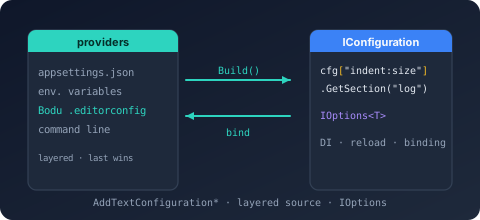
Bodu.Extensions.Configuration.Text is the bridge between
Bodu.Text.Configuration and Microsoft.Extensions.Configuration, and one half of
the Configuration topic. It exposes a
single conventional entry point - IConfigurationBuilder.AddTextConfigurationFile(...) - that adds a Bodu Text
Configuration file (or stream, or pre-parsed document) as a configuration source alongside JSON, INI, XML, and
environment variables.
The overload set deliberately mirrors Microsoft.Extensions.Configuration.Json's AddJsonFile / AddJsonStream
shape, so consumers familiar with the JSON provider can swap in this provider without learning a new API. A second,
read-only TOML bridge (AddTomlFile / AddTomlStream) layers Bodu.Text.Toml
through the same pipeline, and a third, read-only Bencode bridge (AddBencodeFile / AddBencodeStream) does the
same for Bodu.Text.Bencode. Once added, keys are exposed in the canonical
colon-delimited form that IConfiguration consumes:
configuration["logging:level:default"]   // "Warning"
configuration.GetSection("service")      // a child section that binds to your POCO
Core mental model
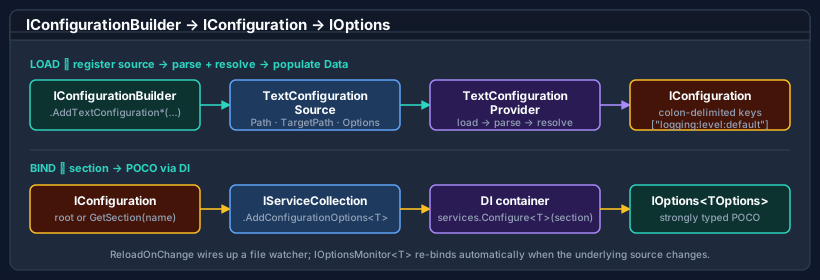
The provider is a thin host around Bodu.Text.Configuration. The builder creates a
TextConfigurationSource (or its stream-only sibling
TextStreamConfigurationSource); the source's Build method instantiates
a TextConfigurationProvider; the provider loads the file, parses it with
the supplied
ConfigurationParseOptions, resolves it for the source's TargetPath using the
supplied ConfigurationResolveOptions, and copies the resolved view into
IConfiguration.Data as colon-delimited keys. The DI extensions (AddConfigurationOptions<T>) bind a named
section to an IOptions<T> instance.
IConfigurationBuilder
  ▶ AddTextConfiguration{File|Stream|Document}(path | stream | document, …)
  ▶ TextConfigurationSource ▶ Build()
  ▶ TextConfigurationProvider.Load()
  ▶ Parse + Resolve via Bodu.Text.Configuration
  ▶ IConfiguration["key:subkey"]
  ▶ services.AddConfigurationOptions<TOptions>(config, "section")
  ▶ IOptions<TOptions>
The shape of the library
Everything lives in the Bodu.Extensions.Configuration.Text namespace.
Builder extensions
The primary entry point. Mirrors AddJsonFile / AddJsonStream exactly so call sites stay familiar.
| Type | Purpose |
|---|---|
| TextConfigurationExtensions | Static class. The AddTextConfiguration* overload family: file path, file path + file provider, configure callback, conventional probe (.boduconfig → bodu.config), stream, and pre-parsed IniDocumentBase. |
| TomlConfigurationExtensions | Static class. The read-only TOML bridge: AddTomlFile(path, optional) and AddTomlStream(stream). Read-once, read-only, no reload-on-change. |
| BencodeConfigurationExtensions | Static class. The read-only Bencode bridge: AddBencodeFile(path, optional) and AddBencodeStream(stream). Read-once, read-only, dictionary-rooted documents only. |
Sources and providers
The plumbing - typically not constructed directly. Use the builder extensions instead.
| Type | Purpose |
|---|---|
| TextConfigurationSource | FileConfigurationSource subclass. Inherits Path, Optional, ReloadOnChange, FileProvider; adds TargetPath, ParseOptions, ResolveOptions. |
| TextConfigurationProvider | FileConfigurationProvider subclass. Reads the file via the standard MEC pipeline and projects the resolved view into Data. |
| TextStreamConfigurationSource | StreamConfigurationSource subclass. One-shot: no reload-on-change. |
| TextStreamConfigurationProvider | The matching stream provider. |
| Internal loader (not public) | Parses + resolves a stream into a flat key/value dictionary; reused by both Text* providers. |
| TomlConfigurationSource | Implements IConfigurationSource directly (not a FileConfigurationSource). Carries Path, Optional, Stream. Read-once - no ReloadOnChange. |
| TomlConfigurationProvider | The matching TOML provider. Flattens the TOML table hierarchy into colon-delimited keys. |
| BencodeConfigurationSource | The Bencode counterpart - implements IConfigurationSource directly with the same Path, Optional, Stream shape. Read-once. |
| BencodeConfigurationProvider | The matching Bencode provider. Requires a dictionary-rooted document and flattens nested dictionaries into colon-delimited keys. |
Options binding
Thin shims over services.Configure<TOptions>(...) - there for discoverability.
| Type | Purpose |
|---|---|
| ConfigurationOptionsExtensions | Static class. AddConfigurationOptions<TOptions>(services, configuration, sectionName) and the section overload AddConfigurationOptions<TOptions>(services, IConfigurationSection). |
Common scenarios
| Scenario | Reach for |
|---|---|
Add a .boduconfig file to the builder |
builder.AddTextConfigurationFile(".boduconfig") |
Conventional probe - try .boduconfig then bodu.config |
builder.AddTextConfiguration() (no-arg) |
| Anchor glob resolution to a specific source path | builder.AddTextConfigurationFile("appsettings.bodu", targetPath: "src/Foo.cs") |
| Optional file - do not throw if missing | builder.AddTextConfigurationFile("appsettings.bodu", optional: true) |
| Reload-on-change | builder.AddTextConfigurationFile("appsettings.bodu", reloadOnChange: true) |
Use a specific IFileProvider |
builder.AddTextConfigurationFile(physicalFileProvider, "appsettings.bodu") |
| Read from a stream (test fixtures, embedded resources) | builder.AddTextConfigurationStream(stream) |
| Wire up everything via a configure callback | builder.AddTextConfigurationFile(src => { src.Path = …; src.TargetPath = …; src.ReloadOnChange = true; }) |
| Bind a section to an options class | services.AddConfigurationOptions<MyOptions>(configuration, "service") |
| Pre-parsed document (already loaded elsewhere) | builder.AddTextConfigurationDocument(document, targetPath: …) |
| Add a read-only TOML file | builder.AddTomlFile("appsettings.toml", optional: true) |
| Add a read-only TOML stream | builder.AddTomlStream(stream) |
| Add a read-only Bencode file | builder.AddBencodeFile("appsettings.bencode", optional: true) |
| Add a read-only Bencode stream | builder.AddBencodeStream(stream) |
Conventional file probe
The no-argument overload probes the builder's base path for two conventional names:
| Order | File name |
|---|---|
| 1 | .boduconfig |
| 2 | bodu.config |
The first file found is added as a configuration source. When neither is present and optional is true, the call is
a no-op; when optional is false, the source surfaces as missing per the standard FileConfigurationProvider
contract.
Reload-on-change
TextConfigurationSource inherits the ReloadOnChange property from FileConfigurationSource. When true, the
provider attaches a file watcher through the configured IFileProvider; any change to the underlying file triggers
a reparse + reload, and any reload tokens issued through IConfiguration fire.
TextStreamConfigurationSource does not support reload-on-change - it parses the stream once when Build is
called, and the stream lifetime ends with that parse. For dynamic stream-backed inputs, rebuild the configuration.
The TOML and Bencode bridges (AddTomlFile / AddTomlStream, AddBencodeFile / AddBencodeStream) are read-once
and read-only by design - they attach no file watcher even for the file overloads, so there is no reloadOnChange
parameter on any of the four methods.
How keys are projected
The provider hands its parsed document to the resolver and copies the resulting
ConfigurationView into the inherited Data dictionary. Under the default
Default key options, the
DotToColon mapping rewrites dotted file keys to the colon
delimiter IConfiguration expects - logging.level.default becomes logging:level:default. Keys are stored under
StringComparer.OrdinalIgnoreCase, matching the JSON and INI providers, so configuration["Logging:Level"] and
configuration["logging:level"] resolve to the same value.
The projection is intentionally lossy relative to the richer document model. Comments, source locations (line/column/path), and duplicate-section provenance are preserved on the parsed ConfigurationDocument but discarded during the flatten. A literal colon inside a key segment cannot survive - once flattened, the colon is the hierarchy delimiter. Consumers who need any of that metadata should depend on ConfigurationDocument directly rather than going through the bridge.
Where to go next
- Core concepts - vocabulary: source vs provider, target path, parse / resolve option propagation, reload-on-change, options binding.
- Getting started - install + minimal samples for the file overload, the stream overload, conventional probe, options binding.
- Bodu.Extensions.Configuration.Text guides - worked patterns, including configuration sources.
- Bodu.Text.Configuration - the underlying parser, resolver, and view model.
- Bodu.Extensions.Configuration.Text API reference - full type-by-type docs.
- Configuration topic - this package and its sibling Bodu.Text.Configuration side by side.