Hashing & Cryptography
Two Bodu packages turn bytes into fixed-size summaries or protected ciphertext, and the line between them is a single question: is there an adversary?
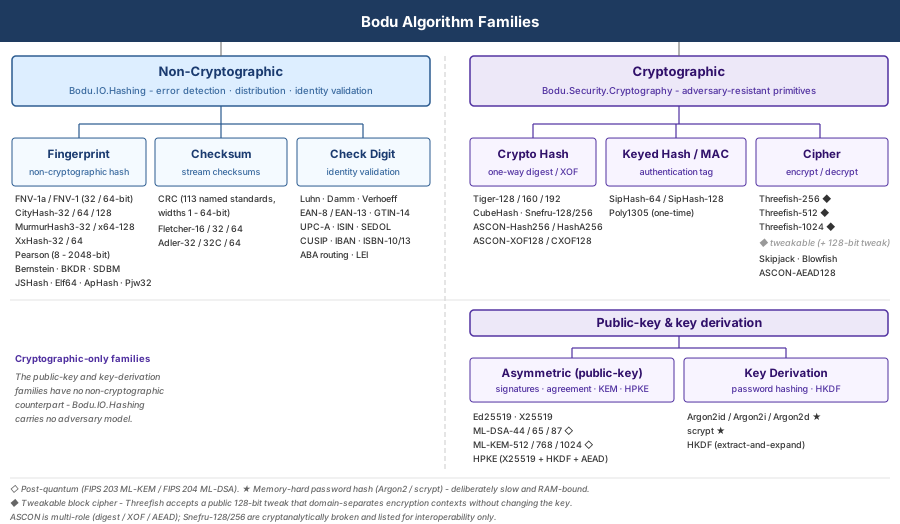
Bodu.IO.Hashing is the non-cryptographic library - fast fingerprints for hash-table keys and caches, error-detecting checksums (CRC, Fletcher, Adler) for transmission and storage channels, and check digits (Luhn, Damm, IBAN, ISBN, …) for human-typed identifiers. Nothing in it carries a security guarantee: every algorithm is trivially forgeable by anyone who controls the bytes, and that is by design - it buys speed, portability, and characterized error coverage on trusted input.
Bodu.Security.Cryptography is the adversarial-setting library - block, tweakable, and stream ciphers, AEAD constructions (block-cipher modes, ASCON, and the Poly1305 stream-cipher pairings), keyed hashes (MACs), cryptographic digests and XOFs, Merkle trees, public-key schemes (Ed25519, X25519, ML-DSA, ML-KEM, HPKE), key-derivation functions (memory-hard Argon2 and scrypt, plus HKDF), and one-time passwords (HOTP / TOTP). Every algorithm is designed against a formal adversary model: it must be computationally infeasible for an attacker - even one who knows the algorithm, observes many inputs and outputs, and chooses inputs adaptively - to forge, invert, or find collisions.
The commitment types sit on the same adversarial side, in the same package: MerkleTree is the RFC 6962 Merkle tree - inclusion and consistency proofs, length-bound roots, and a write-time accumulator - over whatever HashAlgorithm the caller supplies. Its whole purpose is proving something to a party who does not trust you. See the Merkle trees and proofs guide.
Members of this topic
| Package | Status | What it provides | Docs |
|---|---|---|---|
| Bodu.IO.Hashing | Stable | Fingerprints (FNV, CityHash, MurmurHash3, Pearson, the classic string hashes), checksums (Crc with 112 named standards, Fletcher, Adler), and check digits (Luhn, Damm, Verhoeff, EAN, GTIN, ISIN, IBAN, ISBN, SEDOL, CUSIP, ABA, LEI, ISO 7064) - all on the BCL NonCryptographicHashAlgorithm contract. |
Introduction · Concepts · Getting started |
| Bodu.Security.Cryptography | Stable | Block ciphers (Threefish, Serpent, Camellia, Twofish, Blowfish, Skipjack), stream ciphers (ChaCha20, Salsa20 families, Rabbit, HC-128), AES paired with six AEAD mode transforms (GCM, CCM, OCB, EAX, SIV, GCM-SIV), the Poly1305 stream-cipher AEADs (XChaCha20-Poly1305, XSalsa20-Poly1305), MACs (SipHash, Poly1305), cryptographic digests and XOFs (Tiger, Whirlpool, BLAKE2/3, Skein, Shake, ASCON), Merkle trees, public-key schemes (Ed25519, X25519, ML-DSA, ML-KEM, HPKE), KDFs (Argon2, scrypt, HKDF), and one-time passwords (HOTP, TOTP) - the ciphers, digests, MACs, and public-key types on the BCL SymmetricAlgorithm / HashAlgorithm / AsymmetricAlgorithm contracts. |
Introduction · Concepts · Getting started |
Two libraries, one decision
The split is structural, not cosmetic - the packages differ in lineage, posture, and contract:
| Dimension | Bodu.IO.Hashing | Bodu.Security.Cryptography |
|---|---|---|
| Base-class lineage | NonCryptographicHashAlgorithm - Append / GetCurrentHash / Reset, with non-destructive snapshots. |
HashAlgorithm, KeyedHashAlgorithm, and SymmetricAlgorithm - plus Bodu's IBlockCipher and TweakableSymmetricAlgorithm. |
| Performance posture | Tuned for throughput, even distribution, and constant-memory streaming; lookup tables shared across instances. | Pays for security margin - rounds, key schedules, sponge permutations; KDFs are deliberately expensive (memory-hard). |
| Guarantee | Detects accidental errors with characterized coverage (burst errors, transpositions, mistypes); distributes evenly across buckets. | Computationally infeasible to forge a tag, invert a digest, find a collision, or recover plaintext without the key. |
| Attacker assumption | None. Input is trusted; anyone who controls the bytes can forge any output. | Attacker knows the algorithm, observes many inputs/outputs, and chooses inputs adaptively. |
The decision rule
Can an attacker choose or tamper with the input, or does anything secret ride on the result? If yes - keys, authentication, tamper evidence, passwords, attacker-reachable hash tables - use
Bodu.Security.Cryptography. Otherwise - error detection, distribution, fingerprinting, identifier validation on trusted input - useBodu.IO.Hashing.
Cross the line the moment the trust assumption changes. A CRC that guards a download against line noise is correct; the same CRC "guarding" a file against tampering is a vulnerability, because anyone who can modify the file can recompute the CRC.
Important
When you do reach for the cryptographic side, the safety rules from the Bodu.Security.Cryptography introduction apply in full:
- Never reuse a nonce or IV under the same key - stream ciphers and most AEAD modes lose all confidentiality on nonce reuse.
- Always verify the AEAD authentication tag before trusting decrypted plaintext; the transforms reject mismatches with
CryptographicException. - Compare tags and digests in constant time -
CryptographicOperations.FixedTimeEquals, never==orSequenceEqual. - Prefer AEAD over encrypt-then-MAC-by-hand, and prefer the BCL (
Aes,AesGcm, SHA-2/3) where it already covers your case.
Subfamilies at a glance
Bodu.IO.Hashing partitions into three subfamilies, each in its own namespace:
- Fingerprints (
Bodu.IO.Hashing) - even distribution and speed for hash-table keys, cache bucketing, and deduplication. Judged on avalanche and streaming behavior, not error coverage. - Checksums (
Bodu.IO.Hashing.Checksums) - short tags engineered to catch the error patterns of a channel: single-bit flips, burst errors, adjacent transpositions. Polynomial-remainder (Crc) and twin-accumulator (Fletcher, Adler) shapes. - Check digits (
Bodu.IO.Hashing.CheckDigits- decimal, alphanumeric, and multi-character schemes alike) - one or two characters appended to a printed identifier so a later reader can confirm it was not mis-typed.
Bodu.Security.Cryptography spans the cryptographic roles:
- Symmetric ciphers - standard block ciphers, tweakable block ciphers (Threefish, with a public tweak for domain separation), and raw-keystream stream ciphers (confidentiality only - pair with a MAC or prefer AEAD).
- AEAD - authenticated encryption with associated data: ciphertext plus an authentication tag in a single pass, via
AsconAead128, AES paired with the GCM / CCM / OCB / EAX / SIV / GCM-SIV mode transforms, or the Poly1305 stream-cipher constructions (XChaCha20Poly1305,XSalsa20Poly1305Aead, and the libsodium-compatibleXSalsa20Poly1305). - Cryptographic hashes - plain digests, extendable-output functions (XOFs), and tree hashes (BLAKE3, and the RFC 6962
MerkleTreewith its inclusion and consistency proofs). - Keyed hashes / MACs - the reusable PRF (SipHash) and the one-time authenticator (Poly1305).
- Public-key - signatures (
Ed25519, the post-quantumMLDsa44/65/87), key agreement (X25519), key encapsulation (the post-quantumMLKem512/768/1024), andHpke(RFC 9180), which seals a message to a recipient's public key. - KDFs - memory-hard password hashing (Argon2id / Argon2i / Argon2d, scrypt) and the extract-and-expand
Hkdffor high-entropy secrets. - One-time passwords -
Hotp(RFC 4226) andTotp(RFC 6238) code generation and verification.
The lifecycle shape differs accordingly. Non-cryptographic hashes snapshot non-destructively; cryptographic algorithms finalize and dispose:
// Bodu.IO.Hashing - streaming with non-destructive snapshots.
using var crc = new Crc(CrcStandard.CRC32_ISOHDLC);
crc.Append(chunk1);
crc.Append(chunk2);
byte[] checksum = crc.GetCurrentHash();   // snapshot; appending may continue

// Bodu.Security.Cryptography - keyed hash over the BCL HashAlgorithm contract.
using var mac = new SipHash64 { Key = key };
byte[] tag = mac.ComputeHash(message);    // compare with FixedTimeEquals, never ==
Which library do I need?
| Scenario | Reach for | Notes |
|---|---|---|
| Hash-table key inside a trust boundary | Fnv1a64, MurmurHash3_32 (IO.Hashing) |
The default fingerprints; constant-memory streaming. |
| Hash-table keys exposed to attacker-chosen input | SipHash64 / SipHash128 (Cryptography) |
Hash-flooding defense - a keyed PRF, not a fingerprint. |
| File integrity against accidental corruption | Crc, Fletcher32, Adler32 (IO.Hashing) |
Characterized error coverage; pick the published CrcStandard your channel expects. |
| File integrity against tampering | Blake2b, Blake3, AsconHash256 digest - or a MAC / AEAD (Cryptography) |
A digest detects tampering only if the digest itself travels over an authenticated channel. |
| Validate an ISBN, IBAN, credit-card number, or barcode | Isbn10 / Isbn13, Iban, Luhn, Ean13 (IO.Hashing) |
Transcription guards for human-typed identifiers - not unforgeability. |
| Password storage / password-based key derivation | Argon2id (Cryptography) |
Memory-hard KDF per RFC 9106; never a plain digest, never anything from IO.Hashing. |
| Encrypt-then-authenticate a message | AesBlockCipher + GcmModeTransform, or AsconAead128 (Cryptography) |
AEAD bundles confidentiality, integrity, and authenticity in one pass. |
| MAC over API tokens or cookies | SipHash64 / SipHash128 (Cryptography) |
One key authenticates many messages; compare tags in constant time. |
| Per-record / per-sector encryption without re-keying | Threefish256/512/1024 with Tweak, XtsModeTransform (Cryptography) |
Tweakable ciphers give public domain separation. |
| Stream encryption of arbitrary-length data (no padding) | ChaCha20, XChaCha20 (Cryptography) |
Confidentiality only - pair with Poly1305 or prefer AEAD. |
| Deduplication / cache bucketing inside a trust boundary | CityHash64 / CityHash128 (IO.Hashing) |
SIMD-friendly; fastest on long inputs. If dedup keys cross a trust boundary, switch to a cryptographic digest. |
| Verifiable inclusion proofs over many leaves | MerkleTree (Cryptography) |
Root plus logarithmic sibling paths, with a one-call prover and verifier - and the only shape that interoperates with a transparency log. |
| A Merkle root from the same writes that feed a flat digest | MerkleTree.CreateBlockAccumulator (Cryptography) |
Push-style: Append the bytes as they arrive, FinishBound() for the length-bound root. Same root as ComputeRootOfBlocks over the whole input. |
Two BCL notes that both introductions make: for xxHash, use System.IO.Hashing.XxHash32/64/3/128 directly - Bodu does not duplicate them; and prefer the BCL's hardware-accelerated Aes, AesGcm, and SHA-2/3 where they cover your case - reach for Bodu when you need an algorithm the BCL does not ship.
Using both together
Real systems routinely use both packages, each on its own side of the trust boundary. A storage pipeline might CRC each block on the way to disk (accidental-corruption detection, Bodu.IO.Hashing), encrypt and authenticate the payload with an AEAD before it leaves the process (Bodu.Security.Cryptography), and key its in-memory block cache with FNV-1a (trusted input, Bodu.IO.Hashing again). The packages do not overlap, so installing both adds no ambiguity - every algorithm's namespace tells you which guarantee you are getting.
Install
dotnet add package Bodu.IO.Hashing
dotnet add package Bodu.Security.Cryptography
Both target net8.0 and depend only on Bodu.Core (and, for Bodu.IO.Hashing, the BCL's System.IO.Hashing contract). Install only the one you need - they are independent packages.
Where to go next
- Hashing & Cryptography - Concepts - the full taxonomy: fingerprint vs. checksum vs. check digit vs. digest vs. MAC vs. AEAD vs. XOF vs. KDF, and the guarantee each does and does not make.
- Bodu.IO.Hashing introduction - subfamily map and the algorithm-selection tables.
- Merkle trees and proofs - the RFC 6962 tree, inclusion and consistency proofs, bound roots, and the write-time accumulator.
- Bodu.Security.Cryptography introduction - the six subfamilies, the choosing-a-primitive table, and the safety rules.
- Getting started: Bodu.IO.Hashing · Bodu.Security.Cryptography.
- Hashing & Cryptography guides - the recipe-style walk-throughs for this topic.
- API reference: Bodu.IO.Hashing · Bodu.Security.Cryptography.