Using AEAD modes
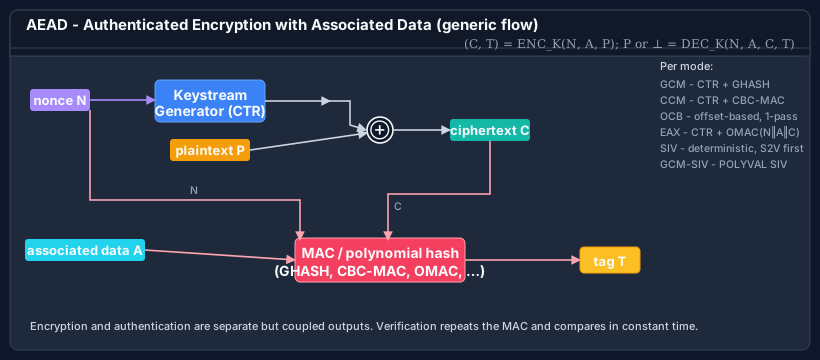
Authenticated encryption with associated data (AEAD) combines confidentiality with integrity: the ciphertext carries a tag that detects any tampering with the ciphertext or with the associated metadata (headers, protocol fields, etc.) that travels alongside it.
Bodu.Security.Cryptography ships six AEAD mode transforms, each implementing IAeadBlockCipherModeTransform. All of them target a 16-byte (128-bit) block cipher - in practice, AES.
| Mode | Class | Standard | Notes |
|---|---|---|---|
| GCM | GcmModeTransform | NIST SP 800-38D | Single-pass; fastest with CLMUL hardware. IV reuse is catastrophic. |
| CCM | CcmModeTransform | NIST SP 800-38C | Two-pass (CTR + CBC-MAC). Fixed 12-byte nonce and 16-byte tag in this implementation. |
| OCB3 | OcbModeTransform | RFC 7253 | Single-pass with offsets; configurable tag length (tagSize in bits - 64 / 96 / 128). |
| EAX | EaxModeTransform | Bellare/Rogaway/Wagner (FSE 2004) | Two-pass (CTR + OMAC); arbitrary nonce length, no length-extension limits. |
| SIV | SivModeTransform | RFC 5297 | Misuse-resistant - same message encrypts to the same ciphertext, but confidentiality is preserved. Needs two independent AES keys. |
| GCM-SIV | GcmSivModeTransform | RFC 8452 | Misuse-resistant successor to GCM; POLYVAL-based. |
The AEAD contract
An AEAD construction delivers all three classical security properties in a single pass:
- Confidentiality - the ciphertext reveals nothing about the plaintext without the key.
- Integrity - any modification of the ciphertext, the tag, or the AAD is detected on decryption.
- Authenticity - a valid tag could only have been produced by a holder of the key.
A raw cipher (CBC, CTR, …) gives confidentiality only: a flipped ciphertext byte still decrypts, just to corrupted plaintext, with nothing to flag the tampering. AEAD folds the authentication step into the same operation that produces the ciphertext, so there is no "decrypt, then check the tag separately" path that a caller can mis-sequence - Decrypt either returns the plaintext or throws.
Three inputs shape every call:
| Input | Role | Constraint |
|---|---|---|
| Key | The shared secret. | Secret; the only value that must never be disclosed. |
| Nonce / IV | Per-message public input that keeps identical plaintexts from encrypting identically. | Unique per message under a given key - see the per-mode notes for size and reuse consequences. |
| AAD | Associated data - headers or framing authenticated but not encrypted. | Public; must match byte-for-byte at decrypt time or the tag check fails. |
The output is the ciphertext (same length as the plaintext) followed by a fixed-size tag. Decryption recomputes the tag over the ciphertext and AAD and compares it in constant time; a mismatch throws and releases no plaintext.
Prerequisites - an AES IBlockCipher
Every mode transform in this family takes an IBlockCipher as its primitive and assumes a 16-byte (128-bit) block size. That assumption is baked into the counter formats, the GHASH/POLYVAL field, and the offset schedules - so the library's other primitives (Skipjack and Blowfish at 8 bytes, Threefish-256/512/1024 at 32/64/128 bytes) are not eligible. AesBlockCipher, which wraps the BCL's hardware-accelerated Aes, is the only primitive that fits.
using System.Security.Cryptography;
using Bodu.Security.Cryptography;

byte[] key = RandomNumberGenerator.GetBytes(16);  // AES-128; 24 or 32 also valid
using var cipher = new AesBlockCipher(key);
AesBlockCipher implements IBlockCipher, exposes a 16-byte block size, and forwards single-block encrypt / decrypt calls to Aes.EncryptEcb / Aes.DecryptEcb. It is the glue that makes every mode transform below usable.
If you need authenticated encryption with one of the non-128-bit ciphers (Skipjack, Blowfish, or Threefish), see the composing primitives guide - you can still use the classic mode transforms (CBC, CTR, etc.) directly with their primitives, and layer your own MAC (HMAC, Poly1305) over the resulting ciphertext for an encrypt-then-MAC construction.
Prerequisites - the extension methods
Calling an IAeadBlockCipherModeTransform directly requires four steps:
- Call
ProcessAssociatedData(aad)(even if the AAD is empty). - Size the output buffer to
plaintext.Length + TagSize / 8(TagSizeis in bits). - Call
Encrypt(plaintext, output)and inspect the returned byte count. - For decrypt, size the output to
ciphertextWithTag.Length - TagSize / 8and callDecrypt.
The Bodu.Security.Cryptography.Extensions.AeadBlockCipherModeTransformExtensions class collapses all of that into a single call that returns a correctly sized byte[]:
using Bodu.Security.Cryptography.Extensions;

byte[] cipherWithTag = aead.Encrypt(plaintext, associatedData: associatedData);
byte[] recovered     = aead.Decrypt(cipherWithTag, associatedData: associatedData);
The examples below all use those extension methods.
GCM - the workhorse
GCM is the default choice for almost any authenticated-encryption workload. It's single-pass, hardware-accelerated, and part of TLS 1.3.
using System.Security.Cryptography;
using Bodu.Security.Cryptography;
using Bodu.Security.Cryptography.Extensions;

byte[] plaintext = System.Text.Encoding.UTF8.GetBytes("secret payload");
byte[] aad       = System.Text.Encoding.UTF8.GetBytes("correlation-id:42");

byte[] key   = RandomNumberGenerator.GetBytes(32);        // AES-256
byte[] nonce = RandomNumberGenerator.GetBytes(12);        // 96-bit GCM nonce - exactly 12 bytes

// Encrypt - produces ciphertext || 16-byte tag
byte[] cipherWithTag;
using (var cipher = new AesBlockCipher(key))
    cipherWithTag = new GcmModeTransform(cipher, nonce).Encrypt(plaintext, associatedData: aad);

// Decrypt - throws CryptographicException if the ciphertext or AAD has been tampered with
byte[] recovered;
using (var cipher = new AesBlockCipher(key))
    recovered = new GcmModeTransform(cipher, nonce).Decrypt(cipherWithTag, associatedData: aad);
Warning
Never reuse a (key, nonce) pair. Doing so in GCM is catastrophic - the XOR of two ciphertexts recovers the XOR of the plaintexts, and an attacker can recover the hash key H and forge arbitrary messages. If you cannot guarantee nonce uniqueness, use SIV or GCM-SIV instead.
On the 12-byte nonce
GcmModeTransform implements the standard 96-bit-nonce profile of NIST SP 800-38D: every constructor (byte[], ReadOnlySpan<byte>, or Nonce) requires exactly 12 bytes and throws ArgumentException for any other length. The transform derives the initial counter block J0 (nonce ‖ 0x00000001) internally - do not build J0 yourself or pass a 16-byte block.
CCM - a two-pass alternative
CCM is the standard AEAD in constrained and legacy environments (Bluetooth LE, older IPsec profiles, IEEE 802.11i). It pairs CTR encryption with CBC-MAC over the formatted message. The library's implementation fixes the deployment profile most commonly used: 12-byte nonce, 16-byte tag, up to 2²⁴−1 byte messages.
byte[] key = RandomNumberGenerator.GetBytes(16);
byte[] iv  = new byte[16];
RandomNumberGenerator.Fill(iv.AsSpan(0, 12));  // first 12 bytes are the CCM nonce

byte[] cipherWithTag;
using (var cipher = new AesBlockCipher(key))
    cipherWithTag = new CcmModeTransform(cipher, iv).Encrypt(plaintext, associatedData: aad);

byte[] recovered;
using (var cipher = new AesBlockCipher(key))
    recovered = new CcmModeTransform(cipher, iv).Decrypt(cipherWithTag, associatedData: aad);
Only the first 12 bytes of the IV are consumed as the nonce; the remaining bytes are ignored.
OCB3 - single-pass, RFC 7253
OCB3 achieves single-pass AEAD through an offset trick: the same per-block offset drives both the cipher and the MAC accumulator. It's typically the fastest software AEAD on CPUs without AES-GCM hardware, and the tag length is configurable.
byte[] key = RandomNumberGenerator.GetBytes(16);
byte[] iv  = new byte[16];
RandomNumberGenerator.Fill(iv.AsSpan(0, 12));  // first 12 bytes are the OCB3 nonce

byte[] cipherWithTag;
using (var cipher = new AesBlockCipher(key))
    // tagSize is in *bits*; default 128. Pass `tagSize: 96` or `tagSize: 64`
    // for the smaller RFC 7253 variants - it must be a multiple of 8 in [8, 128].
    cipherWithTag = new OcbModeTransform(cipher, iv).Encrypt(plaintext, associatedData: aad);

byte[] recovered;
using (var cipher = new AesBlockCipher(key))
    recovered = new OcbModeTransform(cipher, iv).Decrypt(cipherWithTag, associatedData: aad);
EAX - two-pass, FSE 2004
EAX (Bellare, Rogaway and Wagner) is a two-pass authenticated-encryption mode that pairs CTR encryption with OMAC1 authentication. Three OMAC invocations - one each over the nonce, the associated data, and the ciphertext - are XOR-combined to form the tag. EAX has no length-extension restrictions on the nonce or message and avoids GCM's polynomial-MAC pitfalls, making it a safe choice when you need an alternative to GCM without giving up performance to a misuse-resistant mode.
byte[] key = RandomNumberGenerator.GetBytes(16);
byte[] iv  = RandomNumberGenerator.GetBytes(16);  // EAX nonce - must equal the cipher block size

byte[] cipherWithTag;
using (var cipher = new AesBlockCipher(key))
    cipherWithTag = new EaxModeTransform(cipher, iv).Encrypt(plaintext, associatedData: aad);

byte[] recovered;
using (var cipher = new AesBlockCipher(key))
    recovered = new EaxModeTransform(cipher, iv).Decrypt(cipherWithTag, associatedData: aad);
The nonce is the raw value N; the transform internally derives the initial CTR counter as OMAC^0(N) and the authentication tag as OMAC^0(N) ⊕ OMAC^1(aad) ⊕ OMAC^2(ciphertext). The tag length is fixed at 16 bytes.
SIV - misuse-resistant
SIV (RFC 5297) derives its IV from the message itself, so encrypting the same plaintext twice with the same key produces the same ciphertext - but confidentiality is preserved beyond confirming equality, and the scheme does not fail catastrophically on accidental nonce reuse. Use SIV when you cannot guarantee a unique nonce per message (for example, for deterministic key wrapping or for messages replayed across retries).
SIV uses two independent AES keys - one for the S2V / CMAC authentication pass (K₁), one for the CTR encryption pass (K₂):
byte[] s2vKey = RandomNumberGenerator.GetBytes(16);  // K₁
byte[] ctrKey = RandomNumberGenerator.GetBytes(16);  // K₂
byte[] iv     = new byte[16];                        // accepted for interface compatibility

byte[] cipherWithTag;
using (var s2v = new AesBlockCipher(s2vKey))
using (var ctr = new AesBlockCipher(ctrKey))
    cipherWithTag = new SivModeTransform(s2v, ctr, iv).Encrypt(plaintext, associatedData: aad);

byte[] recovered;
using (var s2v = new AesBlockCipher(s2vKey))
using (var ctr = new AesBlockCipher(ctrKey))
    recovered = new SivModeTransform(s2v, ctr, iv).Decrypt(cipherWithTag, associatedData: aad);
The iv argument is kept for interface compatibility but is not used - SIV derives its synthetic IV from the AAD and plaintext.
The associated data is S2V's one associated-data string when it is non-empty. Empty associated data, or none, contributes no string, because the transform cannot tell the two apart; implementations that always pass the associated data as a string, even an empty one, compute a different synthetic IV for such messages.
Important
Earlier releases computed the synthetic IV of an empty plaintext with the wrong padding constant, which does not match RFC 5297. Data they sealed with an empty plaintext does not decrypt with this release; every non-empty plaintext is unchanged.
GCM-SIV - the modern replacement for GCM
GCM-SIV (RFC 8452) is a misuse-resistant AEAD with GCM-like performance. It's the preferred choice when you want GCM's speed and need to tolerate accidental nonce reuse. The construction uses AES internally, but with a key-derivation step - so the constructor takes a master cipher and a factory that produces a new cipher for the derived per-message key.
byte[] masterKey = RandomNumberGenerator.GetBytes(16);
byte[] iv        = new byte[16];
RandomNumberGenerator.Fill(iv.AsSpan(0, 12));  // first 12 bytes are the nonce

byte[] cipherWithTag;
using (var master = new AesBlockCipher(masterKey))
    cipherWithTag = new GcmSivModeTransform(
        master,
        static k => new AesBlockCipher(k),  // factory for the derived per-message cipher
        iv).Encrypt(plaintext, associatedData: aad);

byte[] recovered;
using (var master = new AesBlockCipher(masterKey))
    recovered = new GcmSivModeTransform(
        master,
        static k => new AesBlockCipher(k),
        iv).Decrypt(cipherWithTag, associatedData: aad);
The factory expression static k => new AesBlockCipher(k) is the canonical form - the static modifier avoids a closure allocation.
RFC 8452 defines GCM-SIV for 128- and 256-bit master keys, and the per-message key it derives is as long as the master key. With an AesBlockCipher master the transform reads the key size itself, so a 32-byte master key hands the factory a 32-byte key and the message is encrypted with AES-256. Any other IBlockCipher master derives a 16-byte key unless you pass the size: new GcmSivModeTransform(master, factory, iv, keySize: 256).
Important
Earlier releases derived a 16-byte per-message key for AES-256 master keys too, which does not match RFC 8452. Data they sealed under a 256-bit master key does not decrypt with this release; AES-128 output is unchanged.
One-transform, one-message
Every AEAD transform in this library is stateful and single-use. A second call to Encrypt or Decrypt on the same instance - including after a tag-mismatch failure - throws InvalidOperationException. The contract is enforced uniformly across GcmModeTransform, CcmModeTransform, EaxModeTransform, OcbModeTransform, GcmSivModeTransform, and SivModeTransform.
The pattern throughout these examples is this one:
using (var cipher = new AesBlockCipher(key))
    cipherWithTag = new GcmModeTransform(cipher, iv).Encrypt(plaintext, associatedData: aad);
It constructs a fresh AesBlockCipher and a fresh GcmModeTransform inside the using, runs one encryption, and lets them both fall out of scope. Build a separate transform for the matching Decrypt:
using (var cipher = new AesBlockCipher(key))
    recovered = new GcmModeTransform(cipher, iv).Decrypt(cipherWithTag, associatedData: aad);
Reusing the encrypting transform to decrypt the round-tripped output, or calling Encrypt a second time to encrypt a follow-up message, will throw:
using var cipher = new AesBlockCipher(key);
var aead = new GcmModeTransform(cipher, iv);

byte[] first  = aead.Encrypt(plaintextA, associatedData: aad);
byte[] second = aead.Encrypt(plaintextB, associatedData: aad); // throws InvalidOperationException
The same enforcement applies to Decrypt. After a CryptographicException from a tag-mismatch, the instance is also burned - recover by constructing a fresh transform with the same (key, nonce), never by retrying on the same one.
Tamper detection
Decrypt throws CryptographicException if any part of the ciphertext, the tag, or the AAD has been modified since encryption. The extension methods do not catch it - callers must decide whether to log, retry, or reject:
try
{
    byte[] plaintext = aead.Decrypt(cipherWithTag, associatedData: aad);
    // …proceed with the plaintext
}
catch (CryptographicException)
{
    // Tag did not verify - reject the message entirely.
    // Do not act on any partial plaintext (the extension method does not leak any).
}
On the wire, a failed tag check is indistinguishable from an attack; treat every failure as adversarial.
A full round trip with tamper handling
This self-contained example encrypts, flips a single ciphertext byte, and shows the tag check rejecting the modified message. Each direction builds its own AesBlockCipher and GcmModeTransform because both are single-use (see One-transform, one-message):
using System.Security.Cryptography;
using Bodu.Security.Cryptography;
using Bodu.Security.Cryptography.Extensions;

byte[] key   = RandomNumberGenerator.GetBytes(32);   // AES-256
byte[] nonce = RandomNumberGenerator.GetBytes(12);   // 96-bit nonce - GcmModeTransform requires exactly 12 bytes

byte[] plaintext = System.Text.Encoding.UTF8.GetBytes("transfer £250 to account 9921");
byte[] aad       = System.Text.Encoding.UTF8.GetBytes("txn-id:7f3a");

// Encrypt - ciphertext || 16-byte tag.
byte[] sealed_;
using (var cipher = new AesBlockCipher(key))
    sealed_ = new GcmModeTransform(cipher, nonce).Encrypt(plaintext, associatedData: aad);

// Honest decrypt - recovers the original plaintext.
using (var cipher = new AesBlockCipher(key))
{
    byte[] recovered = new GcmModeTransform(cipher, nonce).Decrypt(sealed_, associatedData: aad);
    // recovered.SequenceEqual(plaintext) == true
}

// Tampered decrypt - flip one ciphertext byte and watch the tag reject it.
sealed_[0] ^= 0x01;
using (var cipher = new AesBlockCipher(key))
{
    try
    {
        _ = new GcmModeTransform(cipher, nonce).Decrypt(sealed_, associatedData: aad);
    }
    catch (CryptographicException)
    {
        // Expected - reject the message; never act on partial output.
    }
}
Modifying the AAD instead of the ciphertext fails identically: pass a different aad to Decrypt and the tag check throws even though every ciphertext byte is intact.
Where to go next
- Encryption basics - the Key / IV / Tweak / Padding lifecycle for the non-AEAD ciphers.
- Cipher block modes - the five classic non-authenticated modes (ECB / CBC / CFB / OFB / CTR).
- Stream ciphers § authenticated stream ciphers - the ready-made
XChaCha20Poly1305,XSalsa20Poly1305Aead, and NaClsecretbox(XSalsa20Poly1305) constructions when you want AEAD over a stream cipher rather than AES. - ASCON AEAD - lightweight authenticated encryption.
- API reference: [AesBlockCipher] · [IAeadBlockCipherModeTransform] · [AeadBlockCipherModeTransformExtensions].
- Hashing & Cryptography guides - every guide in this topic, across Bodu.IO.Hashing and Bodu.Security.Cryptography.