EcbModeTransform Class
Definition
- Namespace
- Bodu.Security.Cryptography
- Assembly
- Bodu.Security.Cryptography.dll
- Package
- Bodu.Security.Cryptography 1.2.0
- Source
- EcbModeTransform.cs
Applies the Electronic Codebook (ECB) mode transformation to an underlying IBlockCipher, encrypting or decrypting each block independently with no chaining.
public sealed class EcbModeTransform : IBlockCipherModeTransform, IDisposable- Inheritance
-
EcbModeTransform
- Implements
- Inherited Members
- Extension Methods
Examples
using System.Security.Cryptography;
using Bodu.Security.Cryptography;

// Most callers should reach for SymmetricAlgorithm.Mode = ECB instead of constructing this directly.
// Direct use is appropriate only inside larger primitives (e.g. wide-block constructions, KDFs).
using IBlockCipher cipher = new AesBlockCipher(key);
IBlockCipherModeTransform ecb = new EcbModeTransform(cipher);
byte[] ciphertext = new byte[plaintext.Length];
int written = ecb.Transform(plaintext, ciphertext, encrypt: true);
Remarks
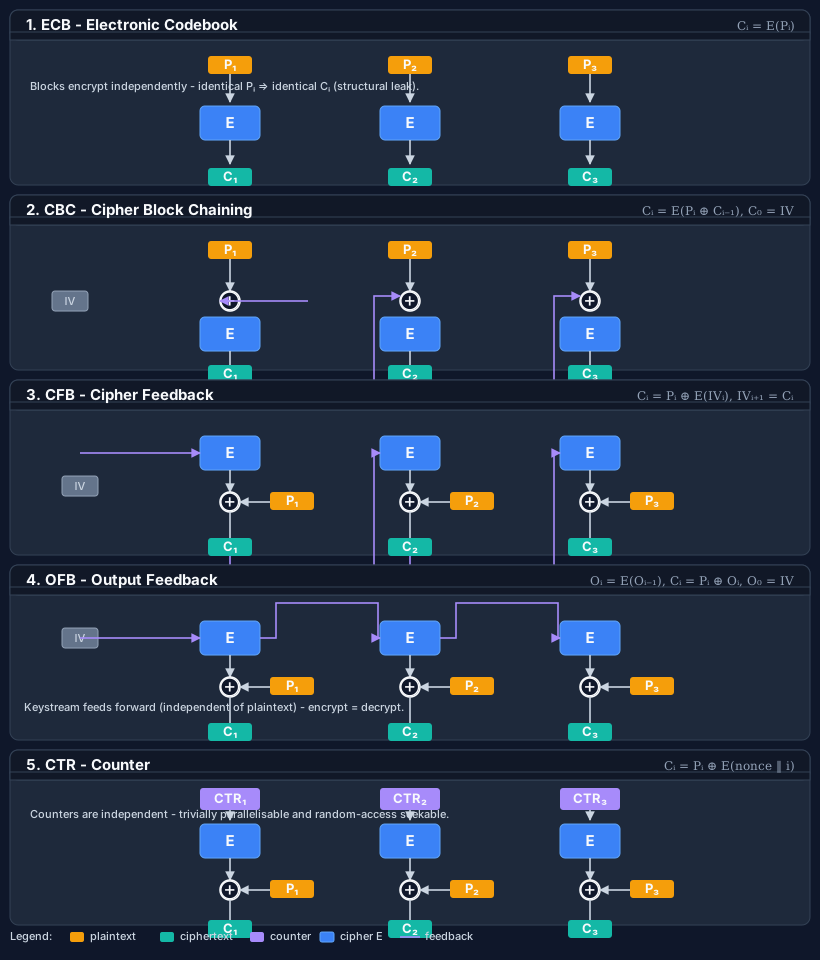
Encryption computes Cᵢ = E(Pᵢ) and decryption Pᵢ = D(Cᵢ); no initialization vector is used. See
panel 1 of the diagram above: each column is entirely self-contained, so the three cells carry no arrows between
them.
That independence is exactly what makes ECB insecure for virtually all real-world messages: identical plaintext blocks always yield identical ciphertext blocks, leaking structural information. Prefer CBC, CTR, or an authenticated mode unless ECB is required as a primitive inside a larger construction.
When to use ECB. Only as a building block inside a larger, well-understood construction - for example, encrypting a single fixed-length tweak inside an XTS or wide-block scheme. For protecting arbitrary plaintext, use CbcModeTransform as a baseline, CtrModeTransform when random access or stream-cipher behavior is wanted, or one of the AEAD modes (GcmModeTransform, EaxModeTransform, …) when authentication matters.
Because ECB has no chaining state, the transform is stateless - repeated Transform(ReadOnlySpan<byte>, Span<byte>, bool) calls produce the same result for the same input - and is trivially parallelisable.
Constructors
EcbModeTransform(IBlockCipher)
Initializes a new instance of the EcbModeTransform class that wraps the specified block cipher.
public EcbModeTransform(IBlockCipher cipher)Parameters
cipherIBlockCipherThe block cipher over which ECB is applied.
Exceptions
- ArgumentNullException
Thrown if
cipheris null.
Methods
Dispose()
Releases the resources used by this instance. ECB holds no per-message chaining state, so this is a no-op beyond satisfying the IBlockCipherModeTransform contract. The underlying IBlockCipher is not disposed by this type - ownership remains with the caller.
public void Dispose()Transform(ReadOnlySpan<byte>, Span<byte>, bool)
Transforms input under the mode's chaining strategy and writes the result to
output.
public int Transform(ReadOnlySpan<byte> input, Span<byte> output, bool encrypt)Parameters
inputReadOnlySpan<byte>The input data to transform. Its length must be a positive multiple of the underlying cipher block size.
outputSpan<byte>The destination span. Its length must be greater than or equal to the length of
input.encryptbool
Returns
- int
The number of bytes written to
output.
Exceptions
- ArgumentException
Thrown when
input's length is not a multiple of the block size or whenoutputis too small.
Applies to
| Product | Versions |
|---|---|
| .NET | 8, 10 |