Bodu.Globalization.Calendar.Builder
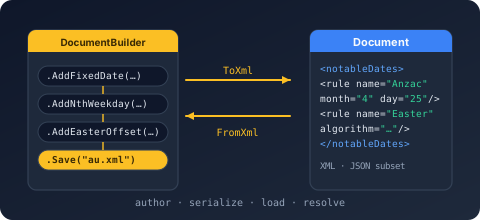
Bodu.Globalization.Calendar.Builder is the fluent C# authoring API for notable-date documents. Instead of hand-writing XML or JSON on the notable-date schema, you compose the document in code - concepts, rules, strategies, adjustment policies, imports, overrides, and the resolution policy - then serialize it, save it, or materialize it straight into a validated NotableDateResource. It is a companion to the runtime in the Globalization & Calendars topic.
The builder never validates on its own. Build() renders the in-memory model to XML and pushes it through NotableDateResourceLoader, so a document authored in code is held to exactly the same rules - and produces exactly the same BODU-CAL-* diagnostics - as one loaded from a file. What you serialize is what the runtime loads.
What the builders author
| Builder | Authors | Entry point |
|---|---|---|
| NotableDateDocumentBuilder | The document: resource id, schema version, metadata, resolution policy, adjustment policies, imports, notable-date concepts, overrides. | Create() / Create(resourceId, schemaVersion), FromXml / FromJson / Load |
| NotableDateDefinitionBuilder | One notable-date concept: display name, category, default duration, default non-working flag, tags, and its rules. | AddNotableDate(id, displayName, category, configure) |
| NotableDateRuleBuilder | One rule: its strategy, territory / calendar scope, year periodicity, priority, category and non-working overrides, duration, tags, and adjustment references. | definition.AddRule(id, configure) |
| AdjustmentPolicyBuilder / AdjustmentScopeBuilder | A reusable adjustment policy - trigger (When), action (Then), emission (Emit) - and the scope it applies to. |
AddAdjustmentPolicy(id, configure) / WithScope(configure) |
| ImportBuilder / ImportUseBuilder | An import of a common catalogue and the <Use> directives that re-scope individual concepts. |
AddImport(resource, configure) / Use(notableDateRef, configure) |
| OverrideBuilder | ID-targeted AddRule / PatchRule / RemoveRule edits applied at load time. |
AddOverride(configure) |
| ResolutionPolicyBuilder | The resource-level duplicate, collision, priority, observed-date-range, working-week, and category-precedence settings. | WithResolutionPolicy(configure) |
Rule strategies
NotableDateRuleBuilder exposes one method per resolution strategy; a rule takes exactly one. The single-date family:
| Method | Strategy |
|---|---|
Fixed(month, day, …) (month as int or name) |
A fixed calendar date, with skipLeapMonth / sweepCalendarYears options. |
DayOfWeekInMonth(month, dayOfWeek, weekOrdinal) |
The nth (or last) weekday of a month. |
WeekdayNearDate(month, day, dayOfWeek, direction) |
The nearest weekday on or before / after a date. |
RelativeWeekdayInMonth(…) |
A weekday relative to another weekday-in-month anchor. |
OffsetFromRule(notableDateRef, offsetDays, ruleRef) |
A day offset from another rule's resolved date. |
Algorithm(key) |
A named algorithm (western-easter, diwali, …) from the registry. |
OrdinalDayOfMonth(month, ordinal), DayOfYear(ordinal), IsoWeekDate(week, dayOfWeek) |
Positional dates. |
WeekdayNearRule(…), NthWeekdayFromRule(…), WorkingDayOffsetFromRule(…), WorkingDayInMonth(month, ordinal) |
Weekday- and working-day-relative rules. |
The frequency-based recurrence family - DailyInterval(anchorDate, intervalDays), Weekly(daysOfWeek, intervalWeeks, anchorDate), MonthlyDay(dayOfMonth, intervalMonths, anchorDate, invalidDayBehavior), MonthlyWeekday(dayOfWeek, weekOrdinal, intervalMonths, anchorDate) - emits a stream of occurrences per year rather than one, and UntilDate(endStrategy, …) turns a single-date rule into a multi-day span that runs until a second strategy's date. Scope and periodicity are set with ForTerritory / ForTerritories, ForCalendar, FromYear / ToYear, EveryYears + AnchorYear, and OnlyYears / ExceptYears; adjustments attach with WithAdjustment(policyRef) / WithAdjustments. The rule authoring guide explains what each strategy computes.
Output and input
| Direction | XML (full fidelity) | JSON (subset) | Binary pack |
|---|---|---|---|
| To text / object | ToXml(), ToXDocument() |
ToJson(), ToJsonObject() |
- |
| To file | Save(path) (by extension) or Save(path, NotableDateDocumentFormat.Xml) |
Save(path, NotableDateDocumentFormat.Json) |
SaveBinary(path) / SaveBinary(stream, importResolver), or Save(path, NotableDateDocumentFormat.Binary) |
| From text / object | FromXml(xml), FromXDocument(document) |
FromJson(json), FromJsonObject(json) |
not re-openable (a pack is compiled output; load it with NotableDateResourceLoader.LoadBinary) |
| From file | Load(path) - .xml or .json inferred from the extension |
XML expresses every feature of the schema. JSON is a narrower subset - it omits imports, restricts calendars to Gregorian, and supports a reduced trigger / action / override surface - so ToJson() throws NotSupportedException for a document that uses a feature the subset cannot represent. NotableDateDocumentFormat names the three forms. The round-trip guarantees guide states exactly what survives each direction.
Materializing
Build()/Build(importResolver)- load and validate through the canonical loader, returning aNotableDateResource; throwsInvalidOperationExceptionfor an incomplete document (no resource id, a concept without rules, a rule without a strategy, a policy missing its trigger, action, or emission) and NotableDateValidationException when the loader reports errors.TryBuild(out resource, out diagnostics)/Validate()- the collect-mode equivalents: every NotableDateValidationDiagnostic is returned rather than thrown. See validation diagnostics.ToProvider()- wrap the built resource in an INotableDateResourceProvider for the reloadable-service workflow.Clone()- an independent copy of the in-memory model, for deriving variants.
Pass an import resolver (CommonNotableDateResources.Resolver, or your own Func<string, string?>) to Build, TryBuild, Validate, and SaveBinary whenever the document declares imports.
Install
dotnet add package Bodu.Globalization.Calendar.Builder
Targets net8.0. Depends on Bodu.Globalization.Calendar (and, through it, Bodu.Core). Status: Stable (see the package matrix).
Minimal sample
using Bodu.Globalization.Calendar;
using Bodu.Globalization.Calendar.Builder;
using Bodu.Globalization.Calendar.RangeResolution;   // EmissionMode

NotableDateDocumentBuilder builder = NotableDateDocumentBuilder.Create("contoso-holidays")
    .AddAdjustmentPolicy("weekend-roll", p => p
        .When(AdjustmentTrigger.IfWeekend)
        .Then(AdjustmentAction.MoveToNextWorkingDay)
        .Emit(EmissionMode.ObservedOnly))
    .AddNotableDate("founders-day", "Founders' Day", NotableDateCategory.Civic, c => c
        .AsNonWorkingByDefault()
        .AddRule("fixed", r => r
            .Fixed(3, 14)
            .ForTerritory("US")
            .WithAdjustment("weekend-roll")))
    .AddNotableDate("quarterly-close", "Quarterly Close", NotableDateCategory.Other, c => c
        .AddRule("last-weekday", r => r
            .WorkingDayInMonth(3, -1)
            .WithTags("finance")));

// Materialize through the canonical loader - same validation as a file on disk.
NotableDateResource resource = builder.Build();
var service = new NotableDateService(resource);

foreach (NotableDate date in service.Resolve(2026, "US"))
    Console.WriteLine($"{date.Date:yyyy-MM-dd} {date.DisplayName}");   // 2026-03-16 Founders' Day (14 Mar is a Saturday), 2026-03-31 Quarterly Close

// The same model serializes to XML or JSON, and reloads.
builder.Save("contoso-holidays.xml");
NotableDateDocumentBuilder reloaded = NotableDateDocumentBuilder.Load("contoso-holidays.xml");
string json = reloaded.ToJson();
Where to go next
- Authoring with the notable-date builder - the builder hierarchy end to end: rules and strategies, adjustment policies, importing the common catalogues, overrides, resolution policy, materializing, saving, and cloning.
- Builder round-trip guarantees - the guarantee matrix for XML, JSON, and
Buildparity, and what is not guaranteed. - Authoring notable date rules - the schema the builder targets, so you can read the XML it emits.
- Binary rule packs -
SaveBinaryand the.bcalformat the tooling compiles. - Bodu.Globalization.Calendar.Builder API reference - full type-by-type docs.
- Bodu.Globalization.Calendar introduction - the runtime the builder feeds.