Authoring notable date rules
A notable date is defined by a rule document on the notable-date schema (urn:bodu:globalization:calendar): author it as XML or JSON, then load it into an immutable NotableDateResource with NotableDateResourceLoader. There is no mutable rule-object graph and no rule-provider interface - a rule is a <Rule> element, and a service is built over the loaded resource. This guide covers the document model directly; to assemble the same document fluently in C# instead, see Authoring with the notable-date builder.
This guide walks the document model top to bottom: the <NotableDateResource> root and its child order, how a <NotableDate> concept carries one or more <Rule> recipes, the <Strategy> and <Recurrence> occurrence sources, importing the bundled common catalogues with <Imports>, and ID-targeted edits with <Overrides>. For the full strategy catalogue see Notable-date rule strategies. For the vocabulary it assumes (document vs. resource, concept vs. rule, nominal vs. observed, territory containment) read Core concepts first. For the per-element field reference, see NotableDateRule and adjustment-policy reference.
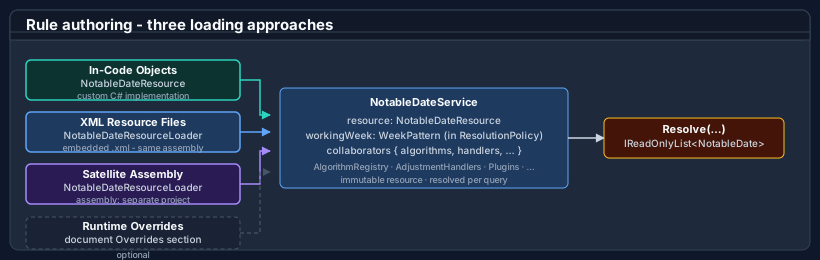
Document structure
A document is a single <NotableDateResource> element. It declares the schema namespace, a schemaVersion, and a resourceId, and contains its child sections in this order:
| Child element | Required | Purpose |
|---|---|---|
<Metadata> |
No | Name, Description, and zero or more Source provenance entries. |
<ResolutionPolicy> |
No | Resource-level duplicate / collision / observed-date policy and the working week. |
<AdjustmentPolicies> |
No | Reusable, named adjustment policies referenced by rules via policyRef. |
<Imports> |
No | Pulls concepts in from the bundled common catalogues. |
<NotableDates> |
No | The locally declared concepts (each with one or more rules). |
<Overrides> |
No | ID-targeted AddRule / PatchRule / RemoveRule edits applied at load time. |
A minimal document declares a single fixed-date concept:
<?xml version="1.0" encoding="utf-8"?>
<NotableDateResource xmlns="urn:bodu:globalization:calendar" schemaVersion="1.0" resourceId="demo">
  <NotableDates>
    <NotableDate id="new-years-day" displayName="New Year's Day" category="PublicHoliday" defaultNonWorkingDay="true">
      <Rules>
        <Rule id="default">
          <Strategy><Fixed month="January" day="1" /></Strategy>
        </Rule>
      </Rules>
    </NotableDate>
  </NotableDates>
</NotableDateResource>
id values follow the schema's identifier pattern - lowercase, digits, and hyphens (new-years-day, good-friday). resourceId additionally allows dots (data.au, common.global-buddhist).
Concepts and rules
A <NotableDate> is one notable-date concept - an id, a displayName, a default category, and a <Rules> block of one or more <Rule> recipes. Optional concept-level attributes set defaults the rules inherit: defaultNonWorkingDay marks the concept as a closure, and defaultDurationDays gives multi-day events their span.
<NotableDate id="anzac-day" displayName="Anzac Day" category="Remembrance" defaultNonWorkingDay="true">
  <Tags>
    <Tag value="national" />
  </Tags>
  <Rules>
    <Rule id="default">
      <Strategy><Fixed month="April" day="25" /></Strategy>
    </Rule>
  </Rules>
</NotableDate>
A <Rule> is one calculation recipe. Its required id distinguishes it from its siblings under the same concept; the optional attributes (priority, category, nonWorking, durationDays, comment) override the concept defaults for that recipe. A rule contains, in order:
- an optional
<Applicability>(calendar, year bounds, territory scope); - exactly one
<Strategy>(the calculation); - an optional
<Tags>block; - an optional
<Adjustments>block ofpolicyRefreferences.
<Rule id="au" priority="100" comment="National; substitute Monday when 26 January falls on a weekend.">
  <Applicability calendar="Gregorian"><Territory code="AU" /></Applicability>
  <Strategy><Fixed month="January" day="26" /></Strategy>
  <Tags><Tag value="national" /></Tags>
  <Adjustments><Adjustment policyRef="weekend-roll" /></Adjustments>
</Rule>
A concept holds several rules when the same date is observed differently across subdivisions or years - for example one Labour-Day rule per Australian state, each scoped to its subdivision and carrying its own <Strategy>. The engine resolves the most-specific rule that applies to the requested territory and year. See NotableDateRule and adjustment-policy reference for every attribute.
The strategy elements
A rule's occurrence source is a <Strategy> child holding exactly one strategy element, each mapping to a public IDateCalculationStrategy. The six most common describe a single date by calendar arithmetic or by reference to another rule:
<Strategy> element |
What it computes |
|---|---|
<Fixed> |
A specific month + day every year (e.g. 1 January), optionally in a non-Gregorian calendar. |
<DayOfWeekInMonth> |
The nth or last weekday in a month (e.g. fourth Thursday in November). |
<WeekdayNearDate> |
A weekday on / before / after / nearest a fixed reference date (e.g. the Monday on or before 24 May). |
<RelativeWeekdayInMonth> |
A weekday positioned relative to a weekday-in-month anchor (e.g. the Tuesday after the first Monday in November). |
<OffsetFromRule> |
A signed day-offset from another rule's occurrence (e.g. Easter Sunday − 2 = Good Friday). |
<Algorithm> |
Delegated to a named algorithm key for astronomical / ecclesiastical dates (Easter, Vesak, Diwali, …). |
A one-line example of each:
<Strategy><Fixed month="January" day="1" /></Strategy>
<Strategy><DayOfWeekInMonth month="11" dayOfWeek="Thursday" weekOrdinal="Fourth" /></Strategy>
<Strategy><WeekdayNearDate month="5" day="24" dayOfWeek="Monday" direction="OnOrBefore" /></Strategy>
<Strategy><RelativeWeekdayInMonth month="11" dayOfWeek="Monday" weekOrdinal="First"
                                  relativeDayOfWeek="Tuesday" direction="After" /></Strategy>
<Strategy><OffsetFromRule notableDateRef="easter-sunday" ruleRef="default" offsetDays="-2" /></Strategy>
<Strategy><Algorithm key="western-easter" /></Strategy>
Alongside these, the schema provides positional strategies (<OrdinalDayOfMonth>, <DayOfYear>, <IsoWeekDate>), dynamic-reference strategies (<WeekdayNearRule>, <NthWeekdayFromRule>), and business-day strategies (<WorkingDayOffsetFromRule>, <WorkingDayInMonth>) that resolve against the working-week and applicable non-working occurrences. A rule may instead declare a <Recurrence> - a repeating cadence (<DailyInterval>, <Weekly>, <MonthlyDay>, <MonthlyWeekday>) that yields many occurrences - and may carry a <Duration> whose end date is either a fixed day count or calculated from a second strategy. The complete catalogue, with a choosing guide and a common-scenarios cookbook, is Notable-date rule strategies.
month accepts either a number (1-12) or an English month name (January). weekOrdinal is a WeekOrdinal value (First…Fifth, Last); direction is a WeekdayProximity value (Before, OnOrBefore, Nearest, OnOrAfter, After). For per-element attribute tables and worked examples see NotableDateRule and adjustment-policy reference; for the <Algorithm> key catalogue and custom algorithms see Date calculation algorithms.
Adjustment policies
A weekend-substitution or "move-to-next-working-day" shift is authored once as a reusable <AdjustmentPolicy> in <AdjustmentPolicies>, then referenced from any rule via <Adjustment policyRef="...">. Adjustments are always referenced by id - there are no inline per-rule adjustment definitions.
<AdjustmentPolicies>
  <AdjustmentPolicy id="weekend-roll" priority="100"
                    description="If the holiday falls on a weekend, observe it on the following Monday.">
    <Trigger type="IfWeekend" />
    <Action type="MoveToNextWorkingDay" skipWeekends="true" skipNonWorkingDates="false" maxSearchDays="7" />
    <Emission mode="ObservedOnly" reason="Substitute public holiday" />
  </AdjustmentPolicy>
</AdjustmentPolicies>
A policy pairs a <Trigger> (when it fires) with an <Action> (what it does) and an <Emission> (whether the actual day, the observed day, or both are emitted), plus an optional <Scope> that limits it to a territory, calendar, category, or year range. A rule opts in by reference:
<Rule id="au">
  <Applicability calendar="Gregorian"><Territory code="AU" /></Applicability>
  <Strategy><Fixed month="January" day="26" /></Strategy>
  <Adjustments><Adjustment policyRef="weekend-roll" /></Adjustments>
</Rule>
The full trigger, action, emission, and scope vocabulary - and the worked weekend-substitution patterns for AU/NZ, the UK, and the US - are covered in Observance adjustment rules and Holiday patterns and examples.
Importing the common catalogues
A regional document rarely starts from scratch. The base package ships a set of common catalogues - global-core, christian-western, global-family, global-remembrance, global-cultural, global-buddhist, global-hindu, and friends - that carry the bare calculation strategy for shared concepts. An <Import> pulls those concepts in; the local document supplies the territory scope, category, non-working flag, and any adjustment.
<Imports>
  <Import resource="global-core">
    <Use notableDateRef="new-years-day" territory="AU">
      <Adjustments><Adjustment policyRef="weekend-roll" /></Adjustments>
    </Use>
  </Import>

  <Import resource="christian-western">
    <Use notableDateRef="good-friday"   territory="AU" />
    <Use notableDateRef="easter-sunday" territory="AU" />
    <Use notableDateRef="easter-monday" territory="AU" />
    <Use notableDateRef="christmas-day" territory="AU">
      <Adjustments><Adjustment policyRef="working-day-substitute" /></Adjustments>
    </Use>
  </Import>
</Imports>
Each <Import resource="..."> names a catalogue. Inside it, a <Use> directive cherry-picks one concept by notableDateRef and may:
- rename it locally with
as, - re-scope it to a
territory, - override the
categoryornonWorkingflag, - attach adjustment policies via a nested
<Adjustments>block.
An <Import> with no <Use> children imports every concept in the catalogue. When a local concept and an imported concept share an id, the local one wins. The catalogue names accepted by the resolver include default-minimal, global-core, global-all, christian-western, christian-orthodox, global-islamic, global-hindu, global-jewish, global-buddhist, global-cultural, global-remembrance, and the UN / health / science / education / environment / food / family / social families.
Loading a document that imports
<Imports> are resolved by a Func<string,string?> passed to the loader. CommonNotableDateResources exposes that resolver over the bundled catalogues - pass CommonNotableDateResources.Resolver:
using Bodu.Globalization.Calendar;

NotableDateResource resource =
    NotableDateResourceLoader.Load(xml, CommonNotableDateResources.Resolver);
NotableDateService service = new NotableDateService(resource);
A document with no <Imports> loads with the single-argument overload, NotableDateResourceLoader.Load(xml). The companion Bodu.Globalization.Calendar.<Region> data packs are built exactly this way - each region resource imports from the common catalogues and is loaded through the same resolver. See Calendar data packs.
ID-targeted overrides
<Overrides> are edits applied at load time, after imports are resolved, targeted by id. They let a regional document tweak an imported concept without forking it. Three operations are available:
<AddRule notableDateRef="...">wraps a new<Rule>and appends it to an existing concept.<PatchRule notableDateRef="..." ruleRef="...">replaces parts of an existing rule. The targeting attributes are required; scalar attributes (priority,category,nonWorking,durationDays,comment) patch in place, and a nested<Applicability>,<Strategy>,<Tags>, or<Adjustments>replaces that section wholesale.<RemoveRule notableDateRef="..." ruleRef="..."/>deletes a single rule.
<Overrides>
  <!-- Suppress an imported rule for this consumer … -->
  <RemoveRule notableDateRef="boxing-day" ruleRef="default" />

  <!-- … bump another rule's priority and re-scope it … -->
  <PatchRule notableDateRef="labour-day" ruleRef="default" priority="200">
    <Applicability calendar="Gregorian"><Territory code="AU-VIC" /></Applicability>
  </PatchRule>

  <!-- … and add a company event to an existing concept. -->
  <AddRule notableDateRef="company-founding-day">
    <Rule id="hq">
      <Applicability calendar="Gregorian"><Territory code="AU" /></Applicability>
      <Strategy><Fixed month="June" day="15" /></Strategy>
    </Rule>
  </AddRule>
</Overrides>
Overrides run during loading and produce a normal immutable resource. Runtime change (swapping the rule set after the service is built) is a separate mechanism: load a new resource and hand it to a MutableNotableDateResourceProvider, then resolve through a ReloadableNotableDateService. See Using NotableDateService.
Authoring in JSON
JSON is an equivalent surface for the same document model; the choice is presentation-only. Load it with NotableDateResourceLoader's LoadJson overloads (LoadJson(json), LoadJson(json, resolver), LoadJson(Stream)). The element names map directly to JSON property names:
{
  "schemaVersion": "1.0",
  "resourceId": "demo",
  "notableDates": [
    {
      "id": "new-years-day",
      "displayName": "New Year's Day",
      "category": "PublicHoliday",
      "defaultNonWorkingDay": true,
      "rules": [
        {
          "id": "default",
          "strategy": { "fixed": { "month": "January", "day": 1 } }
        }
      ]
    }
  ]
}
using Bodu.Globalization.Calendar;

NotableDateResource resource = NotableDateResourceLoader.LoadJson(json, CommonNotableDateResources.Resolver);
The larger sections map the same way: <AdjustmentPolicies> → adjustmentPolicies, with <Trigger> / <Action> / <Emission> becoming the nested trigger / action / emission objects; <Adjustments> becomes an adjustments array of policy-id strings; and <Imports> becomes imports, each entry a resource plus a uses array:
{
  "schemaVersion": "1.0",
  "resourceId": "data.au",
  "adjustmentPolicies": [
    {
      "id": "weekend-roll",
      "priority": 100,
      "trigger": { "type": "IfWeekend" },
      "action": { "type": "MoveToNextWorkingDay", "maxSearchDays": 7 },
      "emission": { "mode": "ObservedOnly", "reason": "Substitute public holiday" }
    }
  ],
  "imports": [
    {
      "resource": "global-core",
      "uses": [
        { "notableDateRef": "new-years-day", "territory": "AU", "adjustments": ["weekend-roll"] }
      ]
    }
  ],
  "notableDates": [
    {
      "id": "australia-day",
      "displayName": "Australia Day",
      "category": "PublicHoliday",
      "defaultNonWorkingDay": true,
      "rules": [
        {
          "id": "au",
          "applicability": { "calendar": "Gregorian", "territories": ["AU"] },
          "strategy": { "fixed": { "month": "January", "day": 26 } },
          "adjustments": ["weekend-roll"]
        }
      ]
    }
  ]
}
JSON and XML are accepted by separate loader entry points - LoadJson for JSON, Load for XML - and produce identical resources; there is no auto-detection.
Year periodicity
Beyond fromYear / toYear bounds, <Applicability> supports a periodicity pair for rules that recur every nth year: everyYears sets the period and anchorYear the reference year it is counted from. A quadrennial civic day active from a known base year is everyYears="4" with anchorYear="2024". They surface on the loaded NotableDateRule's applicability alongside OnlyYears / ExceptYears. See NotableDateRule and adjustment-policy reference.
Validation
Loading parses the document, resolves <Imports>, applies <Overrides>, assembles the concepts, and runs semantic validation. Any error-severity diagnostic throws a NotableDateValidationException; its Diagnostics collection carries every NotableDateValidationDiagnostic ( Severity, Code, Message), so informational and warning diagnostics are visible even when the load succeeds:
using Bodu.Globalization.Calendar;

try
{
    NotableDateResource resource = NotableDateResourceLoader.Load(xml, CommonNotableDateResources.Resolver);
}
catch (NotableDateValidationException ex)
{
    foreach (NotableDateValidationDiagnostic d in ex.Diagnostics)
        Console.WriteLine($"{d.Severity} {d.Code}: {d.Message}");
}
Typical errors include a duplicate concept or rule id, an unknown adjustment policyRef, an unknown <Algorithm> key, an impossible fixed date, or a fromYear after toYear.
Where to go next
- Using NotableDateService - loading resources, querying by date / range / year, and filtering.
- Notable-date rule strategies - every occurrence source and duration, with a choosing guide and common-scenarios cookbook.
- NotableDateRule and adjustment-policy reference - the per-element field reference for the document model.
- Date calculation algorithms - the strategy kinds, the built-in
<Algorithm>keys, and custom algorithms. - Observance adjustment rules - the full trigger / action / emission catalogues for
<AdjustmentPolicy>. - Working with non-Gregorian calendars -
<Fixed>dates in Hijri / Hebrew / Persian / Chinese lunisolar calendars. - Calendar data packs - the official Americas / Asia-Pacific / Europe / Middle East / Africa resources, built from these same imports.
- Bodu.Globalization.Calendar API reference - full type reference.
- Globalization & Calendars guides - every guide in this topic: the runtime, companions, data packs, and the notable-date catalogue.