Using NotableDateService
NotableDateService is the main entry point for resolving notable dates - public holidays, observances, religious festivals, regional events - for a given date, range, or year and territory. It is built over an immutable, already-validated NotableDateResource and resolves NotableDate occurrences on demand.
For the vocabulary used below (document vs. resource, rule vs. resolved date, nominal vs. observed, territory containment, …) see Core concepts.
Pattern 1 - a minimal service from a bundled catalogue
Load one of the bundled common catalogues to create a service without referencing a companion data pack - handy for smoke tests and demos. default-minimal carries just New Year's Day:
using Bodu.Globalization.Calendar;

NotableDateResource resource = NotableDateResourceLoader.Load(
    CommonNotableDateResources.Resolve("default-minimal")!);
var service = new NotableDateService(resource);

IReadOnlyList<NotableDate> dates = service.Resolve(DateTime.Today.Year, "XX");
// → New Year's Day on 1 January
Region-specific public holidays ship in dedicated Bodu.Globalization.Calendar.<Region> companion packages. See Calendar data packs.
Pattern 2 - load a data pack and filter by territory
Each pack exposes a static factory with CreateService(territory) (and LoadResource(territory) if you want the resource alone):
using Bodu.Globalization.Calendar;

// Loads Australia's resource (imports resolved against the bundled catalogues).
NotableDateService service = AsiaPacificCalendarData.CreateService("AU");

// By-year resolution is an extension (NotableDateServiceExtensions.Resolve):
IReadOnlyList<NotableDate> auDates  = service.Resolve(2026, "AU");
IReadOnlyList<NotableDate> nswDates = service.Resolve(2026, "AU-NSW");

foreach (NotableDate date in nswDates)
    Console.WriteLine($"{date.Date:d MMM yyyy}  {date.DisplayName}");
TerritoryCode containment applies: a query for "AU-NSW" returns dates scoped to AU and AU-NSW (plus any unscoped rules), but not other states. See Territories and regional composition.
All examples below assume a service constructed with the relevant data pack.
Pattern 3 - filter by category
NotableDateFilter is a composable predicate built from static factory methods. Pass it to the filtered Resolve overloads:
using Bodu.Globalization.Calendar;

NotableDateService service = EuropeCalendarData.CreateService("GB");

// Only public holidays for Great Britain.
NotableDateFilter publicFilter = NotableDateFilter.ForCategory(NotableDateCategory.PublicHoliday);
IReadOnlyList<NotableDate> holidays = service.Resolve(2026, "GB", publicFilter);

// Non-working public holidays - combine predicates with And:
NotableDateFilter nonWorkingFilter = NotableDateFilter
    .ForCategory(NotableDateCategory.PublicHoliday)
    .And(NotableDateFilter.IsNonWorkingDay());
IReadOnlyList<NotableDate> nonWorking = service.Resolve(2026, "GB", nonWorkingFilter);

// Multiple categories in one call:
NotableDateFilter culturalOrObservance =
    NotableDateFilter.ForAnyCategory(NotableDateCategory.Cultural, NotableDateCategory.Observance);
Pattern 4 - query a date range
using Bodu.Globalization.Calendar;

NotableDateService service = AsiaPacificCalendarData.CreateService("AU");

var window = new DateRange(new DateOnly(2026, 3, 1), new DateOnly(2026, 4, 30));
IReadOnlyList<NotableDate> autumn = service.Resolve(window, "AU");
Multi-day events (DurationDays > 1) are included when their span intersects the query window; which occurrence (actual or observed) controls inclusion is governed by the resource's ObservedDateRangePolicy.
Pattern 5 - query a single day
using Bodu.Globalization.Calendar;

NotableDateService service = AsiaPacificCalendarData.CreateService("AU");

IReadOnlyList<NotableDate> onDay = service.Resolve(new DateOnly(2026, 4, 25), "AU");  // ANZAC Day
This overload also returns multi-day spans whose nominal date lies on a preceding day but whose span covers the queried date.
Pattern 6 - check non-working days and weekends
These are working-day extension methods in Bodu.Extensions (over DateOnly, DateTime, and DateTimeOffset):
using Bodu.Globalization.Calendar;
using Bodu.Extensions;

NotableDateService service = AsiaPacificCalendarData.CreateService("AU");
DateOnly christmas = new DateOnly(2026, 12, 25);

bool isWeekend       = christmas.IsWeekend();                       // weekend per the default Mon-Fri working week
bool isNonWorking    = christmas.IsNonWorkingDay(service, "AU");    // weekend or a non-working notable date
bool isNonWorkingNSW = christmas.IsNonWorkingDay(service, "AU-NSW");
For full working-day arithmetic (IsWorkingDay, AddWorkingDays, NextWorkingDay, SnapToWorkingDay, WorkingDaysBetween, …) see Working-day arithmetic.
Pattern 7 - enumerate and walk notable dates from a date
Beyond Resolve, the Bodu.Extensions surface offers date-anchored convenience methods over DateOnly - the same set exists over DateTime and DateTimeOffset - that fold the year/month boundary calculation and the territory query into a single call:
using Bodu.Globalization.Calendar;
using Bodu.Extensions;

NotableDateService service = AsiaPacificCalendarData.CreateService("AU");
DateOnly anchor = new DateOnly(2026, 4, 1);

// All notable dates in the anchor's calendar month / year:
IReadOnlyList<NotableDate> inApril = anchor.GetNotableDatesInMonth(service, "AU-NSW");
IReadOnlyList<NotableDate> in2026  = anchor.GetNotableDatesInYear(service, "AU-NSW");

// The next / previous notable date relative to the anchor (optionally filtered):
NotableDate? next = anchor.NextNotableDate(service, "AU-NSW",
    NotableDateFilter.ForCategory(NotableDateCategory.PublicHoliday));
NotableDate? prev = anchor.PreviousNotableDate(service, "AU-NSW");

// Lazy enumeration across an arbitrary span (deferred - materialise with ToList where needed):
foreach (NotableDate d in anchor.EnumerateNotableDates(new DateOnly(2026, 12, 31), service, "AU-NSW"))
    Console.WriteLine($"{d.Date:d MMM}  {d.DisplayName}");
GetNotableDates(service, territory) returns the occurrences on the anchor day itself (the same set as service.Resolve(date, territory)), while EnumerateWorkingDays / EnumerateNonWorkingDays yield the bare DateOnly values across a span. NextNotableDate / PreviousNotableDate return a nullable NotableDate? - null when none exists within the search horizon. See Working-day arithmetic for the full method roster.
Pattern 8 - ID-targeted overrides at load time
Because a resource is immutable, edits to imported concepts are authored as ID-targeted <Overrides> in the document and applied during loading - add a rule, patch one, or remove one:
<Overrides>
  <!-- Suppress a base rule … -->
  <RemoveRule notableDateRef="boxing-day" ruleRef="default" />
  <!-- … and add a company event. -->
  <AddRule notableDateRef="company-founding-day">
    <Rule id="default"><Strategy><Fixed month="June" day="15" /></Strategy></Rule>
  </AddRule>
</Overrides>
See Authoring notable date rules for the full override vocabulary.
Pattern 9 - swap the rule set at runtime
A live change means loading a new resource and swapping it in. Build the service over a MutableNotableDateResourceProvider via ReloadableNotableDateService:
using Bodu.Globalization.Calendar;

var provider = new MutableNotableDateResourceProvider(NotableDateResourceLoader.Load(initialXml));
INotableDateService service = new ReloadableNotableDateService(provider);

// later, when the rules change - the live service picks it up atomically:
provider.Reload(NotableDateResourceLoader.Load(updatedXml));
Pattern 10 - discover what a resource covers
A service projects two read-only views off its immutable resource, each computed once at construction:
using Bodu.Globalization.Calendar;

NotableDateService service = AsiaPacificCalendarData.CreateService("AU");

IReadOnlyList<string>         territories = service.GetSupportedTerritories();  // e.g. "AU", "AU-NSW", "AU-VIC", …
IReadOnlyList<CalendarSystem> calendars   = service.GetSupportedCalendars();   // e.g. Gregorian (+ Hijri / Hebrew where used)
GetSupportedTerritories returns every distinct territory mentioned by a rule's <Territory> scope; GetSupportedCalendars returns the distinct CalendarSystem values across the rules' <Applicability calendar="…"> (Gregorian, Hijri, UmmAlQura, Hebrew, Persian, ChineseLunisolar). Both are stable for the life of the service; a reload via the reloadable workflow recomputes them for the new resource.
Pattern 11 - supply custom collaborators
The single-argument new NotableDateService(resource) covers documents that reference only built-in algorithms and policies. Documents that reference a custom <Algorithm key="…">, a CollisionPolicy.Custom resolver, custom adjustment trigger / action handlers, or code-first occurrence providers wire those collaborators through NotableDateServiceOptions - an object with five init-only slots - passed to the second constructor:
using Bodu.Globalization.Calendar;

var service = new NotableDateService(resource, new NotableDateServiceOptions
{
    Algorithms        = algorithmRegistry,      // INotableDateAlgorithmRegistry - custom <Algorithm key>
    CollisionResolver = collisionResolver,      // INotableDateCollisionResolver - CollisionPolicy.Custom
    Handlers          = actionHandlers,         // IAdjustmentHandlerRegistry    - AdjustmentAction.Custom
    TriggerHandlers   = triggerHandlers,        // IAdjustmentTriggerHandlerRegistry - AdjustmentTrigger.Custom
    Providers         = codeFirstProviders,     // IEnumerable<INotableDateProvider>
});
Every slot is optional and defaults to null. There is no positional-collaborator constructor - pass only the slots a document needs. See Building and extending the service.
Working with NotableDate results
NotableDate is an immutable record. Key members:
| Member | Description |
|---|---|
Date |
The emitted (observed) date - the post-adjustment date to display. |
ActualDate |
The originally calculated (nominal) date. |
IsObserved |
Whether Date differs from ActualDate because an adjustment applied. |
EndDate |
The inclusive last day (Date + DurationDays − 1). |
DurationDays |
Span in days (1 for single-day events). |
DisplayName |
The display name (subject to optional localisation). |
Category |
NotableDateCategory value. |
Priority |
Tie-break weight carried from the rule; consulted by the collision policy when several dates share a day. |
TerritoryCode |
The territory the date applies to. |
IsNonWorkingDay |
Whether the date is flagged as a non-working day. |
AdjustmentPolicyId, AdjustmentReason |
Which adjustment policy moved the date, and why (when IsObserved). |
Identity (NotableDateId, RuleId) |
The originating concept and rule. |
Tags |
Optional non-exclusive classification tags. |
foreach (NotableDate date in service.Resolve(2026, "AU"))
{
    Console.WriteLine($"{date.Date:d}  {date.DisplayName}");

    if (date.DurationDays > 1)
        Console.WriteLine($"  Multi-day: ends {date.EndDate:d}");

    if (date.IsObserved)
        Console.WriteLine($"  Observed (nominal was {date.ActualDate:d}, via {date.AdjustmentPolicyId})");
}
Expanding observed-only results into a full timeline
Data packs whose adjustment policies emit ObservedOnly return a single occurrence per adjusted date, anchored on the observed (substitute) day - the nominal day survives only in ActualDate. When you want the full sequential story, WithActualOccurrences() on NotableDateSequenceExtensions synthesizes the missing actual occurrences and re-sorts by the standard Resolve ordering - the consumer-side equivalent of an ActualAndObserved emission:
NotableDateService service = AsiaPacificCalendarData.CreateService("AU");

// 2021: Christmas (Sat 25th) and Boxing Day (Sun 26th) were both observed on the following
// working days, so the observed-only pack returns occurrences dated 27 and 28 December.
IReadOnlyList<NotableDate> resolved = service.Resolve(
    new DateRange(new DateOnly(2021, 12, 24), new DateOnly(2021, 12, 29)), "AU");

// Expand: 25 and 26 December reappear as actual occurrences → 24, 25, 26, 27, 28.
IReadOnlyList<NotableDate> timeline = resolved.WithActualOccurrences();

foreach (NotableDate date in timeline)
    Console.WriteLine($"{date.Date:d}  {date.DisplayName}  {(date.IsObserved ? "(observed)" : "(actual)")}");
Synthesized occurrences match the shape the engine emits for the actual half of ActualAndObserved (IsObserved is false, no adjustment policy or reason, all other fields - including DisplayName - unchanged), and expansion skips occurrences whose actual day is already present, so the method is idempotent and a no-op for packs that already emit both. A synthesized date can precede the range you originally queried; apply NotableDateFilter.InDateRange afterwards if strict containment matters.
Composing filters
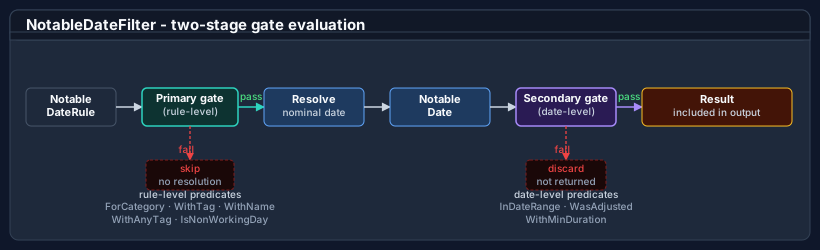
NotableDateFilter is a predicate over resolved occurrences (Matches(NotableDate)). Build one from the static factories and combine them:
// Category + non-working:
NotableDateFilter nonWorkingHolidays = NotableDateFilter
    .ForCategory(NotableDateCategory.PublicHoliday)
    .And(NotableDateFilter.IsNonWorkingDay());

// Observed (adjusted) occurrences only:
NotableDateFilter adjusted = NotableDateFilter.WasAdjusted();

// Category pre-screen + date-range:
NotableDateFilter easterWeek = NotableDateFilter
    .ForCategory(NotableDateCategory.PublicHoliday)
    .And(NotableDateFilter.InDateRange(new DateOnly(2026, 4, 1), new DateOnly(2026, 4, 14)));

// AllOf / AnyOf for multi-filter composition:
NotableDateFilter combined = NotableDateFilter.AllOf(
    NotableDateFilter.ForCategory(NotableDateCategory.PublicHoliday),
    NotableDateFilter.IsNonWorkingDay(),
    NotableDateFilter.WithTag("national"));
The factory set: ForCategory, ForAnyCategory, WithName, WithAnyName, WithId, WithTag, WithAnyTag, WithAllTags, WithMinDuration, IsNonWorkingDay, WasAdjusted, InDateRange, combined with And, Or, Not, AllOf, AnyOf.
Understanding the resolution pipeline
Loading turns a document into a resource; querying turns a resource into occurrences:
NotableDateResourceLoader.Load(xml[, resolver][, algorithms])
   parse → resolve <Imports> → apply <Overrides> → assemble → validate
      → immutable NotableDateResource
NotableDateService.Resolve(date | range | year, territory[, filter])
   strategy → nominal date → adjustment policies → observed date
      → duplicate/collision settlement → emission → NotableDate set
- Load -
NotableDateResourceLoaderparses the document, resolves<Imports>through the supplied resolver, applies<Overrides>, assembles the definitions, and runs semantic validation, throwingNotableDateValidationExceptionon any error-severity diagnostic. - Resolve - for each applicable rule the IDateCalculationStrategy computes the nominal date; the referenced AdjustmentPolicy shifts it to the observed date when a trigger matches.
- Settle - the resource's ResolutionPolicy reconciles duplicates and same-day collisions and decides which occurrences are emitted.
See The resolution pipeline for the full walk-through with a concrete trace.
Where to go next
- Core concepts - the vocabulary used throughout this guide.
- Territories and regional composition - how
TerritoryCodeand containment govern query results. - Working-day arithmetic -
IsWorkingDay,AddWorkingDays,NextWorkingDay, snap operations. - Calendar data packs - the official Americas / Asia-Pacific / Europe / Middle East / Africa companion packages.
- Authoring notable date rules - XML / JSON documents, imports, and overrides.
- Date calculation algorithms - the built-in keys and how to implement a custom algorithm.
- Bodu.Globalization.Calendar API reference - full type reference.
- Globalization & Calendars guides - every guide in this topic: the runtime, companions, data packs, and the notable-date catalogue.