Padding
Block ciphers encrypt fixed-size blocks. When a plaintext is not a whole number of blocks long, the last block has to be padded - and the receiver has to know how to unpad it. This page covers the padding schemes supported by the library and shows when each one is appropriate.
The five framework modes come from the standard PaddingMode enum. Set them via the algorithm's Padding property, or construct a strategy directly through PaddingFactory. An extended PaddingModeKind enum mirrors those values and adds ISO/IEC 7816-4 bit padding for scenarios where the framework enum is not expressive enough.
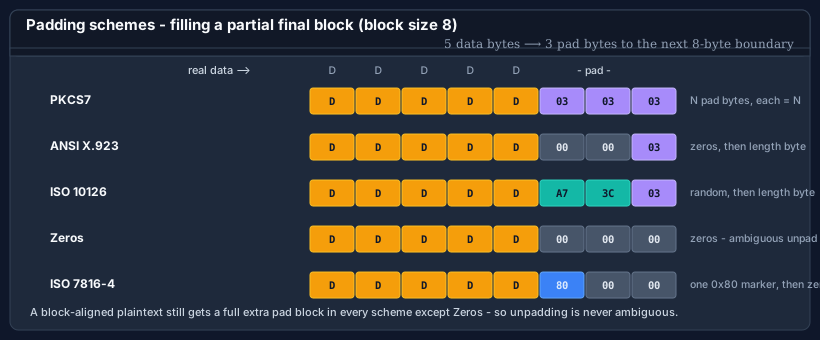
Every scheme is one IPaddingStrategy implementation: Pad(plaintext, blockSize) extends the input to a block boundary, and Unpad(padded, blockSize) reverses it. PaddingFactory.Create has two overloads - one keyed on the BCL PaddingMode, one on PaddingModeKind (the only way to reach ISO7816_4). The SymmetricAlgorithm wrappers construct the matching strategy for you from whichever of Padding / BlockPadding you set - see Encryption basics for how those two properties stay in sync.
Note
Self-describing schemes always grow. PKCS7, ANSI X.923, and ISO/IEC 7816-4 each append a full extra block when the plaintext is already block-aligned. That is deliberate: it guarantees the final byte (or the rightmost 0x80) unambiguously marks the padding, so Unpad can never mistake real data for filler. Only Zeros and None leave block-aligned input untouched - and those two cannot self-describe, so the caller must already know the true length.
PKCS7 - the safe default
Use for: any block-oriented mode (CBC, ECB) where the plaintext is arbitrary binary or text.
PKCS7 appends N bytes, each with the value N, where N is chosen to bring the plaintext to the next block boundary. When the plaintext is already block-aligned, an entire extra block of block_size bytes is appended, each carrying the value block_size. That sounds wasteful but it's what makes unpadding unambiguous: the last byte always tells you how many pad bytes to strip.
using var alg = new Threefish256
{
    BlockMode = CipherModeKind.CBC,
    Padding   = PaddingMode.PKCS7,
};
alg.GenerateKey();
alg.GenerateIV();
alg.GenerateTweak();

byte[] plaintext  = new byte[100];      // not a multiple of 32
byte[] ciphertext = alg.Encrypt(plaintext);
byte[] recovered  = alg.Decrypt(ciphertext);

Debug.Assert(plaintext.SequenceEqual(recovered));
PKCS7 round-trips cleanly for any plaintext length, including zero.
Note on padding oracles. PKCS7 unpadding validates the trailing bytes and rejects a ciphertext whose last block is not well-formed. Historically this has been the source of "padding oracle" attacks against CBC when an attacker can distinguish a padding failure from a MAC failure via timing or error messages. The library validates in constant time inside Pkcs7Padding.Unpad, but you should still pair CBC-with-PKCS7 encryption with a MAC over the ciphertext (encrypt-then-MAC) when the ciphertext travels across a trust boundary.
Zeros - for application-framed messages
Use for: plaintexts that already carry their own length (a length prefix, a terminator, or a framed binary record) and are produced with a deterministic shape.
Zero padding appends 0x00 bytes until the plaintext reaches a block boundary. It does nothing when the plaintext is already block-aligned. The problem with unpadding is that 0x00 is a perfectly valid plaintext byte - Unpad strips trailing zeros, and it cannot tell whether those zeros were padding or part of the real message.
using var alg = new Threefish256
{
    BlockMode = CipherModeKind.CBC,
    Padding   = PaddingMode.Zeros,
};
alg.GenerateKey();
alg.GenerateIV();
alg.GenerateTweak();

// Plaintext has a length prefix, so trailing zeros are unambiguous.
byte[] plaintext = BuildMessageWithLengthPrefix(body: new byte[97]);
byte[] ciphertext = alg.Encrypt(plaintext);
byte[] recovered  = alg.Decrypt(ciphertext);

// Recovered may end in extra 0x00 bytes; consult the length prefix to strip them.
Zero padding is appropriate when the application layer already knows the real length. If it doesn't, prefer PKCS7.
ANSI X.923 - length byte, zero-filled interior
Use for: interoperability with legacy systems or specifications that mandate ANSI X.923.
ANSI X.923 appends N - 1 bytes of value 0x00 followed by a trailing byte holding the padding length N. When the plaintext is already block-aligned, a full extra block of padding is appended so unpadding remains unambiguous. Unpad validates in constant time that all interior pad bytes are 0x00 and that the trailing length byte is in range.
using var alg = new Threefish256
{
    BlockMode = CipherModeKind.CBC,
    Padding   = PaddingMode.ANSIX923,
};
alg.GenerateKey();
alg.GenerateIV();
alg.GenerateTweak();

byte[] plaintext  = new byte[100];
byte[] ciphertext = alg.Encrypt(plaintext);
byte[] recovered  = alg.Decrypt(ciphertext);
The same padding-oracle caution as PKCS7 applies: pair with a MAC when the ciphertext crosses a trust boundary.
ISO 10126 - length byte, random interior
Use for: interoperability with existing ISO 10126 ciphertexts. The scheme was withdrawn by ISO in 2007 and is not recommended for new designs - prefer PKCS7.
ISO 10126 is shaped like ANSI X.923 except the interior pad bytes are cryptographically random instead of 0x00. Because the random bytes cannot be reconstructed during decryption, Unpad only validates the trailing length byte.
using var alg = new Threefish256
{
    BlockMode = CipherModeKind.CBC,
    Padding   = PaddingMode.ISO10126,
};
ISO/IEC 7816-4 - bit padding (one-and-zeros)
Use for: smart-card protocols and crypto constructions that require the 7816-4 shape (for example CMAC, SHA-3/Keccak). Access this mode through the extended PaddingModeKind enum, which is not part of the framework PaddingMode surface.
ISO/IEC 7816-4 appends a single 0x80 byte followed by 0x00 bytes out to the next block boundary. When the plaintext is already block-aligned, a full extra block of padding is appended. Unpad scans the final block in constant time for the rightmost 0x80: everything after it must be 0x00, and the byte itself marks the end of the plaintext.
IPaddingStrategy bitPadding = PaddingFactory.Create(PaddingModeKind.ISO7816_4);

byte[] padded   = bitPadding.Pad(plaintext, blockSize: 256);    // block size in bits - 256 for Threefish-256
byte[] unpadded = bitPadding.Unpad(padded, blockSize: 256);
None - only for block-aligned or stream modes
Use for: stream-shaped modes (CTR, CFB, OFB) that don't need padding, or when you have already padded the plaintext in your own code and want the cipher to leave it alone.
// Stream-shaped mode: ciphertext length == plaintext length.
using var alg = new Threefish256
{
    BlockMode = CipherModeKind.CTR,
    Padding   = PaddingMode.None,
};
alg.GenerateKey();
alg.GenerateIV();
alg.GenerateTweak();

byte[] plaintext  = new byte[100];     // any length is fine
byte[] ciphertext = alg.Encrypt(plaintext);    // 100 bytes out
byte[] recovered  = alg.Decrypt(ciphertext);
PaddingMode.None combined with a block-oriented mode (CBC, ECB) and a plaintext that isn't a multiple of the block size will throw CryptographicException during encryption. Don't use the two together unless you know your plaintext is block-aligned.
Choosing - quick guide
| If your plaintext is… | and your mode is… | Use | Ciphertext length |
|---|---|---|---|
| Arbitrary bytes | CBC, ECB | PKCS7 | Plaintext + 1-block bytes |
| Framed (length-prefixed / terminated) | CBC, ECB | Zeros or PKCS7 | ≥ plaintext, to next block boundary |
| Any length | CTR, CFB, OFB | None | Exactly plaintext length |
| Already block-aligned | CBC, ECB | None (if sure) | Exactly plaintext length |
| Interop with ANSI X.923 spec | CBC, ECB | ANSIX923 | Plaintext + 1-block bytes |
| Interop with legacy ISO 10126 ciphertext | CBC, ECB | ISO10126 | Plaintext + 1-block bytes |
| Smart-card / CMAC / bit-oriented protocols | CBC, ECB | ISO7816_4 (via PaddingModeKind) |
Plaintext + 1-block bytes |
Using the strategy directly
For advanced scenarios you can obtain an IPaddingStrategy directly and apply it to a byte span:
using Bodu.Security.Cryptography;
using System.Security.Cryptography;

IPaddingStrategy pkcs7 = PaddingFactory.Create(PaddingMode.PKCS7);

byte[] padded   = pkcs7.Pad(plaintext, blockSize: 256);         // block size in bits - 256 for Threefish-256
byte[] unpadded = pkcs7.Unpad(padded, blockSize: 256);
IPaddingStrategy.Pad / Unpad take the block size in bits (the same unit as IBlockCipher.BlockSize), so pass 256 for Threefish-256, 128 for AES, Camellia, Twofish, or Serpent-128, and 64 for Blowfish or Skipjack. This is primarily useful if you're composing a custom encryption pipeline against IBlockCipherModeTransform.
Padding oracles - the one caveat that spans schemes
The length-describing schemes (PKCS7, ANSI X.923, ISO 10126, ISO/IEC 7816-4) must validate their trailing bytes during Unpad, and a ciphertext whose final block is malformed is rejected. Historically that rejection became an oracle: when an attacker can tell a padding failure apart from a downstream MAC failure - via a distinct exception, error code, or response time - they can decrypt CBC ciphertext byte by byte without the key.
This library closes the timing half of that gap: the validations in Pkcs7Padding.Unpad, Ansix923Padding.Unpad, and the ISO/IEC 7816-4 strategy scan the final block in constant time. But constant-time unpadding alone does not make CBC safe across a trust boundary - an attacker can still observe whether unpadding threw. The durable fix is to authenticate the ciphertext:
- Encrypt-then-MAC - compute a MAC (for example SipHash or HMAC) over
IV ‖ ciphertext, verify it in constant time before decrypting, and abort on mismatch so the padding step never runs on attacker-modified data; or - Use an AEAD mode - GCM / OCB / EAX / SIV verify the tag before releasing any plaintext, removing the padding-oracle surface entirely. AEAD is the recommended default.
Where to go next
- Cipher block modes - which padding pairs with which mode.
- Encryption basics - the full Key/IV/Tweak/Padding lifecycle.
- Hashing & Cryptography guides - every guide in this topic, across Bodu.IO.Hashing and Bodu.Security.Cryptography.