CompoundFile Class
Definition
Represents an OLE2 / Compound File Binary (CFB) container opened over a path or stream, exposing its storage hierarchy, the metadata of every entry, and the byte payload of each named stream for reading or editing.
public sealed class CompoundFile : IDisposable- Inheritance
-
CompoundFile
- Implements
- Inherited Members
- Extension Methods
Examples
The following example opens a compound file, walks its top-level entries, and reads one named stream. The instance
is disposed by the using declaration, which also closes the source stream unless leaveOpen is set.
using Bodu.IO.Compound;

using CompoundFile file = CompoundFile.Open(File.OpenRead("book.xls"));
foreach (CompoundEntryInfo info in file.RootStorage.EnumerateEntries())
    Console.WriteLine($"{info.EntryType}: {info.Name} ({info.Length} bytes)");

if (file.RootStorage.TryOpenStream("Workbook", out CompoundStream? workbook))
{
    using (workbook)
        // ... read the BIFF records from the workbook stream ...
}
Remarks
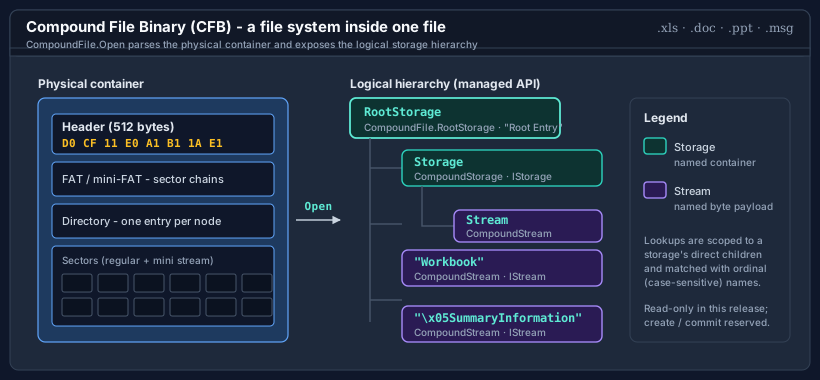
A compound file is a structured-storage envelope - effectively a small file system embedded in a single file - used
by legacy Microsoft Office formats (.xls, .doc, .ppt, .msg) and other technologies. This
type is the managed counterpart of the COM StgOpenStorage entry point: navigation begins at
RootStorage and descends through nested CompoundStorage objects to the
CompoundStream leaves.
By default a read-only file buffers the entire source into memory when opened, so access after opening never touches
the original source and the read-only instance is safe to share across threads. Opening read-only with
buffered: false instead reads sectors on demand from a seekable stream - bounding memory for large files - in
which case the stream must stay open for the instance's lifetime and reads are serialized rather than parallel.
Opening with Read yields a read-only file.
Create(Stream, bool, CompoundBuildOptions) (or a creating
FileMode) starts a new writable file, and Open with ReadWrite loads
an existing file for editing. Edits are staged in memory and written to the destination only by
Commit() (which rewrites the whole container); Revert() discards them. Mutating an
existing file requires read access - write-only access is supported only for creating modes.
Properties
Access
Gets the access level the compound file was opened with.
public FileAccess Access { get; }Property Value
- FileAccess
The FileAccess supplied at open time.
CanRead
Gets a value indicating whether the compound file can be read.
public bool CanRead { get; }Property Value
CanWrite
Gets a value indicating whether the compound file can be written.
public bool CanWrite { get; }Property Value
IsDirty
Gets a value indicating whether the file has staged edits that have not been committed.
public bool IsDirty { get; }Property Value
RootStorage
Gets the root storage that anchors the compound file's directory hierarchy.
public CompoundStorage RootStorage { get; }Property Value
- CompoundStorage
The root CompoundStorage.
Methods
Commit()
Writes the staged contents of a writable file to its destination, clearing the dirty state.
public void Commit()Remarks
The destination is truncated and the whole container is rewritten from the staging tree. When the destination is not seekable, the committed bytes are appended at the current position.
Exceptions
- InvalidOperationException
Thrown when the file is read-only.
- ObjectDisposedException
Thrown when the file has been disposed.
- CompoundFileSerializationException
Thrown when the staging tree cannot be represented.
CommitAsync(CancellationToken)
Asynchronously writes the staged contents of a writable file to its destination, clearing the dirty state.
public Task CommitAsync(CancellationToken cancellationToken = default)Parameters
cancellationTokenCancellationTokenA token that cancels the commit before or during the write.
Returns
- Task
A task that completes when the container has been written and flushed.
Remarks
The asynchronous counterpart of Commit(), sharing the same layout computation. Cancellation is observed before any destination mutation and again during the write; a cancellation or failure mid-write leaves the destination partially written and the file dirty - the same surface a synchronous Commit() fault presents - so call CommitAsync(CancellationToken) (or Commit()) again, or Revert().
Exceptions
- InvalidOperationException
Thrown when the file is read-only.
- ObjectDisposedException
Thrown when the file has been disposed.
- CompoundFileSerializationException
Thrown when the staging tree cannot be represented.
- OperationCanceledException
Thrown when
cancellationTokenis canceled.
Create(Stream, bool, CompoundBuildOptions)
Creates a new, empty writable compound file whose staged contents are written to the supplied destination by Commit().
public static CompoundFile Create(Stream destination, bool leaveOpen = false, CompoundBuildOptions options = default)Parameters
destinationStreamThe stream the committed compound file is written to.
leaveOpenbooltrue to leave
destinationopen when the returned instance is disposed; otherwise false.optionsCompoundBuildOptionsThe build options applied when the staging tree is serialized.
Returns
- CompoundFile
A new writable CompoundFile.
Examples
using FileStream output = File.Create("book.xls");
using CompoundFile file = CompoundFile.Create(output);
using (CompoundStream stream = file.RootStorage.CreateStream("Workbook"))
    stream.Write(workbookBytes);
file.Commit();
Remarks
Edits made through RootStorage are staged in memory; nothing is written to
destination until Commit() is called. Disposing the file without committing
discards the staged edits.
Exceptions
- ArgumentNullException
Thrown when
destinationis null.
Create(string, CompoundBuildOptions)
Creates a new, empty writable compound file whose staged contents are written to the file at the specified path by Commit().
public static CompoundFile Create(string path, CompoundBuildOptions options = default)Parameters
pathstringThe path of the file the committed compound file is written to.
optionsCompoundBuildOptionsThe build options applied when the staging tree is serialized.
Returns
- CompoundFile
A new writable CompoundFile.
Remarks
The returned instance owns the created file and closes it when disposed. Edits are staged in memory until Commit() is called; disposing without committing leaves the file empty.
Exceptions
- ArgumentNullException
Thrown when
pathis null.
Dispose()
Performs application-defined tasks associated with freeing, releasing, or resetting unmanaged resources.
public void Dispose()Flush()
Writes the staged contents of a writable file to its destination, clearing the dirty state.
public void Flush()Remarks
This is an alias for Commit(), named for parity with stream-style consumers.
Exceptions
- InvalidOperationException
Thrown when the file is read-only.
- ObjectDisposedException
Thrown when the file has been disposed.
- CompoundFileSerializationException
Thrown when the staging tree cannot be represented.
FlushAsync(CancellationToken)
Asynchronously writes the staged contents of a writable file to its destination, clearing the dirty state.
public Task FlushAsync(CancellationToken cancellationToken = default)Parameters
cancellationTokenCancellationTokenA token that cancels the write.
Returns
- Task
A task that completes when the container has been written and flushed.
Remarks
This is an alias for CommitAsync(CancellationToken), named for parity with stream-style consumers.
Exceptions
- InvalidOperationException
Thrown when the file is read-only.
- ObjectDisposedException
Thrown when the file has been disposed.
- CompoundFileSerializationException
Thrown when the staging tree cannot be represented.
IsCompoundFile(Stream)
Determines whether the supplied stream begins with the compound-file (OLE2) signature without parsing the file.
public static bool IsCompoundFile(Stream stream)Parameters
streamStreamA seekable stream to inspect; its position is restored before the method returns.
Returns
Examples
Probe a file cheaply before committing to a full open:
using FileStream source = File.OpenRead(path);
if (CompoundFile.IsCompoundFile(source))
{
    using CompoundFile file = CompoundFile.Open(source, leaveOpen: true);
    // ...
}
Exceptions
- ArgumentNullException
Thrown when
streamis null.- ArgumentException
Thrown when
streamis not seekable.
IsCompoundFile(ReadOnlySpan<byte>)
Determines whether the supplied bytes begin with the compound-file (OLE2) signature.
public static bool IsCompoundFile(ReadOnlySpan<byte> data)Parameters
dataReadOnlySpan<byte>The bytes to inspect.
Returns
Open(Stream, CompoundFileOptions, bool)
Opens an existing compound file over the supplied stream for read-only access using the supplied options.
public static CompoundFile Open(Stream stream, CompoundFileOptions options, bool leaveOpen = false)Parameters
streamStreamThe stream containing the compound file; read from its current position to the end.
optionsCompoundFileOptionsThe options controlling the read strategy and validation level.
leaveOpenbooltrue to leave
streamopen when the returned instance is disposed; otherwise false.
Returns
- CompoundFile
An open, read-only CompoundFile.
Exceptions
- ArgumentNullException
Thrown when
streamoroptionsis null.- CompoundFileFormatException
Thrown when the stream content is not a well-formed compound file.
Open(Stream, bool, bool)
Opens an existing compound file over the supplied stream for read-only access, buffering its content into memory by default.
public static CompoundFile Open(Stream stream, bool leaveOpen = false, bool buffered = true)Parameters
streamStreamThe stream containing the compound file; read from its current position to the end.
leaveOpenbooltrue to leave
streamopen when the returned instance is disposed; otherwise false.bufferedbooltrue (the default) to read the whole file into memory at open time; false to read sectors on demand from the seekable
stream, bounding memory for large files. When false, the stream must remain open and unmodified for the lifetime of the returned instance.
Returns
- CompoundFile
An open, read-only CompoundFile.
Examples
using CompoundFile file = CompoundFile.Open(File.OpenRead("book.xls"));
using FileStream source = File.OpenRead("large.msg");
using CompoundFile streamed = CompoundFile.Open(source, buffered: false);
Exceptions
- ArgumentNullException
Thrown when
streamis null.- ArgumentException
Thrown when
bufferedis false andstreamis not seekable.- CompoundFileFormatException
Thrown when the stream content is not a well-formed compound file.
Open(Stream, FileMode, FileAccess, bool, bool)
Opens a compound file over the supplied stream with BCL-style FileMode and
FileAccess semantics, mirroring System.IO.Packaging.Package.Open.
public static CompoundFile Open(Stream stream, FileMode mode, FileAccess access, bool leaveOpen = false, bool buffered = true)Parameters
streamStreamThe stream containing the compound file, or the destination for a writable file.
modeFileModeThe file mode. Open with Read opens for reading; a creating mode (Create/CreateNew, or OpenOrCreate over empty content) with write access starts a new file; Open with ReadWrite loads an existing file for editing.
accessFileAccessThe access level. Mutating an existing file requires ReadWrite; write-only access is supported only for creating modes.
leaveOpenbooltrue to leave
streamopen when the returned instance is disposed; otherwise false.bufferedbooltrue (the default) to read the whole file into memory at open time; false to read sectors on demand from the seekable
stream. Ignored for writable files.
Returns
- CompoundFile
An open CompoundFile.
Remarks
Write access loads the existing content (for Open and a non-empty
OpenOrCreate) or starts empty (for Create,
CreateNew, and an empty OpenOrCreate) into a staging tree. Edits
are written back to stream - which must be writable and seekable - only by
Commit(), which rewrites the whole container.
Exceptions
- ArgumentNullException
Thrown when
streamis null.- NotSupportedException
Thrown when the combination of
modeandaccessis not supported.- CompoundFileFormatException
Thrown when the stream content is not a well-formed compound file.
Open(string, FileMode, FileAccess, FileShare)
Opens the compound file at the specified path with BCL-style FileMode, FileAccess,
and FileShare semantics, mirroring System.IO.Packaging.Package.Open.
public static CompoundFile Open(string path, FileMode mode, FileAccess access, FileShare share = FileShare.Read)Parameters
pathstringThe path of the compound file to open or create.
modeFileModeThe file mode. Open with Read opens for reading; a creating mode with write access starts a new file; Open with write access loads the existing file for update.
accessFileAccessThe access level. Write access requires a creating or updating
mode.shareFileShareThe sharing mode granted to other openers of the file.
Returns
- CompoundFile
An open CompoundFile that owns and closes the underlying file when disposed.
Remarks
For writable modes the staged edits are written back to the file only by Commit(); disposing without committing leaves the file unchanged.
Exceptions
- ArgumentNullException
Thrown when
pathis null.- FileNotFoundException
Thrown when
moderequires an existing file but none exists atpath.- NotSupportedException
Thrown when the combination of
modeandaccessis not supported.- CompoundFileFormatException
Thrown when the existing file content is not a well-formed compound file.
OpenRead(string)
Opens an existing compound file at the specified path for read-only access, buffering its content into memory.
public static CompoundFile OpenRead(string path)Parameters
pathstringThe path of the compound file to open.
Returns
- CompoundFile
An open, read-only CompoundFile.
Examples
using CompoundFile file = CompoundFile.OpenRead("book.xls");
foreach (CompoundEntryInfo info in file.RootStorage.EnumerateEntries())
    Console.WriteLine($"{info.EntryType}: {info.Name}");
Remarks
The returned instance owns the opened file and closes it when disposed. The file is opened with Read, so it does not lock out other readers.
Exceptions
- ArgumentNullException
Thrown when
pathis null.- FileNotFoundException
Thrown when no file exists at
path.- CompoundFileFormatException
Thrown when the file content is not a well-formed compound file.
OpenRead(string, CompoundFileOptions)
Opens an existing compound file at the specified path for read-only access using the supplied options.
public static CompoundFile OpenRead(string path, CompoundFileOptions options)Parameters
pathstringThe path of the compound file to open.
optionsCompoundFileOptionsThe options controlling the read strategy and validation level.
Returns
- CompoundFile
An open, read-only CompoundFile.
Remarks
The returned instance owns the opened file and closes it when disposed. The file is opened with Read, so it does not lock out other readers.
Exceptions
- ArgumentNullException
Thrown when
pathoroptionsis null.- FileNotFoundException
Thrown when no file exists at
path.- CompoundFileFormatException
Thrown when the file content is not a well-formed compound file.
Revert()
Discards all staged edits since the file was opened.
public void Revert()Remarks
For a file opened in update mode this restores the contents loaded at open time; for a newly created file it restores the empty root storage.
Exceptions
- InvalidOperationException
Thrown when the file is read-only.
- ObjectDisposedException
Thrown when the file has been disposed.
SetDocumentSummaryInformation(DocumentSummaryInformation)
Writes the standard document-summary-information property set into the root storage, creating or replacing the stream.
public void SetDocumentSummaryInformation(DocumentSummaryInformation summary)Parameters
summaryDocumentSummaryInformationThe document summary information to write.
Remarks
The write counterpart of TryGetDocumentSummaryInformation(out DocumentSummaryInformation): the
record's underlying PropertySet is staged as the
\x05DocumentSummaryInformation stream and persisted when Commit() is called.
Exceptions
- ArgumentNullException
Thrown when
summaryis null.- ObjectDisposedException
Thrown when the file has been disposed.
- InvalidOperationException
Thrown when the file is read-only.
SetSummaryInformation(SummaryInformation)
Writes the standard summary-information property set into the root storage, creating or replacing the stream.
public void SetSummaryInformation(SummaryInformation summary)Parameters
summarySummaryInformationThe summary information to write.
Remarks
The write counterpart of TryGetSummaryInformation(out SummaryInformation): the record's
underlying PropertySet is staged as the \x05SummaryInformation stream
and persisted when Commit() is called.
Exceptions
- ArgumentNullException
Thrown when
summaryis null.- ObjectDisposedException
Thrown when the file has been disposed.
- InvalidOperationException
Thrown when the file is read-only.
TryGetDocumentSummaryInformation(out DocumentSummaryInformation)
Attempts to read the document-summary-information property set from the root storage.
public bool TryGetDocumentSummaryInformation(out DocumentSummaryInformation summary)Parameters
summaryDocumentSummaryInformationWhen this method returns true, the parsed DocumentSummaryInformation; otherwise null.
Returns
Exceptions
- ObjectDisposedException
Thrown when the file has been disposed.
- CompoundFileFormatException
Thrown when the property-set stream is malformed.
TryGetSummaryInformation(out SummaryInformation)
Attempts to read the standard summary-information property set from the root storage.
public bool TryGetSummaryInformation(out SummaryInformation summary)Parameters
summarySummaryInformationWhen this method returns true, the parsed SummaryInformation; otherwise null.
Returns
Exceptions
- ObjectDisposedException
Thrown when the file has been disposed.
- CompoundFileFormatException
Thrown when the property-set stream is malformed.
Applies to
| Product | Versions |
|---|---|
| .NET | 8, 10 |