CompoundStream Class
Definition
Provides seekable access to the bytes of a single stream within a compound file.
public sealed class CompoundStream : Stream, IAsyncDisposable, IDisposable- Inheritance
-
CompoundStream
- Implements
- Inherited Members
- Extension Methods
Examples
The following example opens a compound file, navigates to a named stream, and reads its leading bytes through the cursor.
using Bodu.IO.Compound;

using CompoundFile file = CompoundFile.Open(File.OpenRead("book.xls"));
using CompoundStream stream = file.RootStorage.OpenStream("Workbook");
byte[] signature = new byte[8];
stream.ReadExactly(signature);

// Seek back to the start and hand the cursor to any Stream consumer.
stream.Seek(0, SeekOrigin.Begin);
using var reader = new BinaryReader(stream);
ushort recordType = reader.ReadUInt16();
Remarks
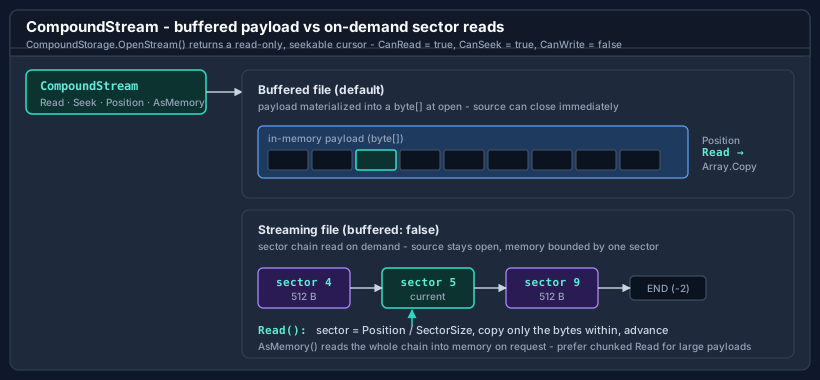
CompoundStream is a standard Stream cursor obtained from OpenStream(string), so it composes with the BCL surfaces that consume a Stream - StreamReader, BinaryReader, CopyTo(Stream), and the deserializers built on top of them.
A stream opened from a buffered compound file is backed by an in-memory payload assembled at open time. A stream
opened from a streaming compound file (see Open(Stream, bool, bool) with
buffered: false) reads its sectors on demand from the underlying source, so it never materializes the whole
payload. In the streaming case the owning CompoundFile and its source must remain open for the
lifetime of the cursor.
A stream opened from a writable compound file (see
Create(Stream, bool, CompoundBuildOptions)) is
backed by a growable in-memory buffer: CanWrite is true, and
Write(byte[], int, int) and SetLength(long) mutate the buffer. The edits are staged in
memory and are persisted to the underlying destination only when Commit() is called;
closing the cursor flushes its buffer into the staging tree but does not write to the destination. A writable cursor
holds at most MaxValue bytes - payloads beyond that are authored through the deferred stream
sources on CompoundStorageBuilder (AddStream(name, openRead, length)
or AddStreamFromFile), which never buffer the whole payload.
A read-only cursor (CanWrite is false) throws NotSupportedException from Write(byte[], int, int) and SetLength(long). Because reads against a streaming source advance a shared position, a single cursor is not safe for concurrent use; open one cursor per reader.
Properties
CanRead
When overridden in a derived class, gets a value indicating whether the current stream supports reading.
public override bool CanRead { get; }Property Value
CanSeek
When overridden in a derived class, gets a value indicating whether the current stream supports seeking.
public override bool CanSeek { get; }Property Value
CanWrite
When overridden in a derived class, gets a value indicating whether the current stream supports writing.
public override bool CanWrite { get; }Property Value
Length
When overridden in a derived class, gets the length in bytes of the stream.
public override long Length { get; }Property Value
- long
A long value representing the length of the stream in bytes.
Exceptions
- NotSupportedException
A class derived from
Streamdoes not support seeking and the length is unknown.- ObjectDisposedException
Methods were called after the stream was closed.
- ObjectDisposedException
Thrown when the cursor has been disposed.
Name
Gets the directory name of the stream.
public string Name { get; }Property Value
- string
The stream name as stored in the compound-file directory.
Parent
Gets the storage that owns this stream cursor.
public CompoundStorage? Parent { get; }Property Value
- CompoundStorage
The owning CompoundStorage, or null when not available.
Position
When overridden in a derived class, gets or sets the position within the current stream.
public override long Position { get; set; }Property Value
- long
The current position within the stream.
Exceptions
- IOException
An I/O error occurs.
- NotSupportedException
The stream does not support seeking.
- ObjectDisposedException
Methods were called after the stream was closed.
- ArgumentOutOfRangeException
Thrown on set when the value is negative.
- ObjectDisposedException
Thrown when the cursor has been disposed.
Stat
Gets the metadata snapshot for this stream entry.
public CompoundEntryInfo Stat { get; }Property Value
- CompoundEntryInfo
A CompoundEntryInfo describing the stream's name, size, class id, and timestamps.
Methods
AsMemory()
Returns a read-only view over the entire stream payload, materializing it for an on-demand stream.
public ReadOnlyMemory<byte> AsMemory()Returns
- ReadOnlyMemory<byte>
A ReadOnlyMemory<T> spanning the payload bytes.
Examples
using CompoundStream stream = storage.OpenStream("Workbook");
ReadOnlyMemory<byte> payload = stream.AsMemory();
ushort recordType = BinaryPrimitives.ReadUInt16LittleEndian(payload.Span);
Remarks
For a buffered stream this returns a view over the already-materialized payload without copying; for a streaming stream it reads the whole payload into memory; for a writable stream it returns the bytes written so far. The returned view does not advance or depend on Position. Prefer chunked Read(Span<byte>) for large streaming payloads.
Dispose(bool)
Releases the unmanaged resources used by the Stream and optionally releases the managed resources.
protected override void Dispose(bool disposing)Parameters
Flush()
When overridden in a derived class, clears all buffers for this stream and causes any buffered data to be written to the underlying device.
public override void Flush()Remarks
For a writable cursor this flushes the buffered bytes into the staging tree and marks the owning file dirty; the destination is written only by Commit(). For a read-only cursor this is a no-op.
Exceptions
- IOException
An I/O error occurs.
- ObjectDisposedException
Thrown when the cursor has been disposed.
FlushAsync(CancellationToken)
Asynchronously clears all buffers for this stream, causes any buffered data to be written to the underlying device, and monitors cancellation requests.
public override Task FlushAsync(CancellationToken cancellationToken)Parameters
cancellationTokenCancellationTokenThe token to monitor for cancellation requests. The default value is None.
Returns
- Task
A task that represents the asynchronous flush operation.
Exceptions
- ObjectDisposedException
The stream has been disposed.
- OperationCanceledException
The cancellation token was canceled. This exception is stored into the returned task.
Read(byte[], int, int)
When overridden in a derived class, reads a sequence of bytes from the current stream and advances the position within the stream by the number of bytes read.
public override int Read(byte[] buffer, int offset, int count)Parameters
bufferbyte[]An array of bytes. When this method returns, the buffer contains the specified byte array with the values between
offsetand (offset+count- 1) replaced by the bytes read from the current source.offsetintThe zero-based byte offset in
bufferat which to begin storing the data read from the current stream.countintThe maximum number of bytes to be read from the current stream.
Returns
- int
The total number of bytes read into the buffer. This can be less than the number of bytes requested if that many bytes are not currently available, or zero (0) if
countis 0 or the end of the stream has been reached.
Exceptions
- ArgumentException
The sum of
offsetandcountis larger than the buffer length.- ArgumentNullException
bufferis null.- ArgumentOutOfRangeException
offsetorcountis negative.- IOException
An I/O error occurs.
- NotSupportedException
The stream does not support reading.
- ObjectDisposedException
Methods were called after the stream was closed.
Read(Span<byte>)
When overridden in a derived class, reads a sequence of bytes from the current stream and advances the position within the stream by the number of bytes read.
public override int Read(Span<byte> buffer)Parameters
bufferSpan<byte>A region of memory. When this method returns, the contents of this region are replaced by the bytes read from the current source.
Returns
- int
The total number of bytes read into the buffer. This can be less than the size of the buffer if that many bytes are not currently available, or zero (0) if the buffer's length is zero or the end of the stream has been reached.
Exceptions
- NotSupportedException
Thrown when the cursor is write-only.
- ObjectDisposedException
Thrown when the cursor has been disposed.
ReadAllBytes()
Copies the entire stream payload into a new byte array, independent of the current position.
public byte[] ReadAllBytes()Returns
Remarks
Mirrors File.ReadAllBytes for callers that consume the whole stream in one pass. Prefer
AsMemory() when a zero-copy view suffices, or chunked Read(Span<byte>) for large
streaming payloads.
ReadAsync(byte[], int, int, CancellationToken)
Asynchronously reads a sequence of bytes from the current stream, advances the position within the stream by the number of bytes read, and monitors cancellation requests.
public override Task<int> ReadAsync(byte[] buffer, int offset, int count, CancellationToken cancellationToken)Parameters
bufferbyte[]The buffer to write the data into.
offsetintThe byte offset in
bufferat which to begin writing data from the stream.countintThe maximum number of bytes to read.
cancellationTokenCancellationTokenThe token to monitor for cancellation requests. The default value is None.
Returns
- Task<int>
A task that represents the asynchronous read operation. The value of the
TResultparameter contains the total number of bytes read into the buffer. The result value can be less than the number of bytes requested if the number of bytes currently available is less than the requested number, or it can be 0 (zero) ifcountis 0 or if the end of the stream has been reached.
Exceptions
- ArgumentNullException
bufferis null.- ArgumentOutOfRangeException
offsetorcountis negative.- ArgumentException
The sum of
offsetandcountis larger than the buffer length.- NotSupportedException
The stream does not support reading.
- ObjectDisposedException
The stream has been disposed.
- InvalidOperationException
The stream is currently in use by a previous read operation.
- OperationCanceledException
The cancellation token was canceled. This exception is stored into the returned task.
ReadAsync(Memory<byte>, CancellationToken)
Asynchronously reads a sequence of bytes from the current stream, advances the position within the stream by the number of bytes read, and monitors cancellation requests.
public override ValueTask<int> ReadAsync(Memory<byte> buffer, CancellationToken cancellationToken = default)Parameters
bufferMemory<byte>The region of memory to write the data into.
cancellationTokenCancellationTokenThe token to monitor for cancellation requests. The default value is None.
Returns
- ValueTask<int>
A task that represents the asynchronous read operation. The value of its Result property contains the total number of bytes read into the buffer. The result value can be less than the length of the buffer if that many bytes are not currently available, or it can be 0 (zero) if the length of the buffer is 0 or if the end of the stream has been reached.
Remarks
This is truly asynchronous only for a streaming-mode cursor, which reads its sectors on demand from the underlying source; a buffered or writable cursor reads from memory and completes synchronously.
Exceptions
- OperationCanceledException
The cancellation token was canceled. This exception is stored into the returned task.
Seek(long, SeekOrigin)
When overridden in a derived class, sets the position within the current stream.
public override long Seek(long offset, SeekOrigin origin)Parameters
offsetlongA byte offset relative to the
originparameter.originSeekOriginA value of type SeekOrigin indicating the reference point used to obtain the new position.
Returns
- long
The new position within the current stream.
Exceptions
- IOException
An I/O error occurs.
- NotSupportedException
The stream does not support seeking, such as if the stream is constructed from a pipe or console output.
- ObjectDisposedException
Methods were called after the stream was closed.
- ObjectDisposedException
Thrown when the cursor has been disposed.
SetLength(long)
When overridden in a derived class, sets the length of the current stream.
public override void SetLength(long value)Parameters
valuelongThe desired length of the current stream in bytes.
Remarks
A writable cursor buffers its payload in memory and supports at most MaxValue bytes; author
larger payloads through a deferred stream source (AddStream(name, openRead, length) or
AddStreamFromFile).
Exceptions
- IOException
An I/O error occurs.
- NotSupportedException
The stream does not support both writing and seeking, such as if the stream is constructed from a pipe or console output.
- ObjectDisposedException
Methods were called after the stream was closed.
- NotSupportedException
Thrown when the cursor is read-only, or when
valueexceeds the MaxValue writable-cursor payload cap.- ObjectDisposedException
Thrown when the cursor has been disposed.
Write(byte[], int, int)
When overridden in a derived class, writes a sequence of bytes to the current stream and advances the current position within this stream by the number of bytes written.
public override void Write(byte[] buffer, int offset, int count)Parameters
bufferbyte[]An array of bytes. This method copies
countbytes frombufferto the current stream.offsetintThe zero-based byte offset in
bufferat which to begin copying bytes to the current stream.countintThe number of bytes to be written to the current stream.
Exceptions
- ArgumentException
The sum of
offsetandcountis greater than the buffer length.- ArgumentNullException
bufferis null.- ArgumentOutOfRangeException
offsetorcountis negative.- IOException
An I/O error occurred, such as the specified file cannot be found.
- NotSupportedException
The stream does not support writing.
- ObjectDisposedException
Write(byte[], int, int) was called after the stream was closed.
Write(ReadOnlySpan<byte>)
When overridden in a derived class, writes a sequence of bytes to the current stream and advances the current position within this stream by the number of bytes written.
public override void Write(ReadOnlySpan<byte> buffer)Parameters
bufferReadOnlySpan<byte>A region of memory. This method copies the contents of this region to the current stream.
Remarks
A writable cursor buffers its payload in memory and supports at most MaxValue bytes; author
larger payloads through a deferred stream source (AddStream(name, openRead, length) or
AddStreamFromFile).
Exceptions
- NotSupportedException
Thrown when the cursor is read-only, or when the write would grow the payload beyond the MaxValue writable-cursor cap.
- ObjectDisposedException
Thrown when the cursor has been disposed.
WriteAsync(byte[], int, int, CancellationToken)
Asynchronously writes a sequence of bytes to the current stream, advances the current position within this stream by the number of bytes written, and monitors cancellation requests.
public override Task WriteAsync(byte[] buffer, int offset, int count, CancellationToken cancellationToken)Parameters
bufferbyte[]The buffer to write data from.
offsetintThe zero-based byte offset in
bufferfrom which to begin copying bytes to the stream.countintThe maximum number of bytes to write.
cancellationTokenCancellationTokenThe token to monitor for cancellation requests. The default value is None.
Returns
- Task
A task that represents the asynchronous write operation.
Exceptions
- ArgumentNullException
bufferis null.- ArgumentOutOfRangeException
offsetorcountis negative.- ArgumentException
The sum of
offsetandcountis larger than the buffer length.- NotSupportedException
The stream does not support writing.
- ObjectDisposedException
The stream has been disposed.
- InvalidOperationException
The stream is currently in use by a previous write operation.
- OperationCanceledException
The cancellation token was canceled. This exception is stored into the returned task.
- NotSupportedException
Thrown when the cursor is read-only.
WriteAsync(ReadOnlyMemory<byte>, CancellationToken)
Asynchronously writes a sequence of bytes to the current stream, advances the current position within this stream by the number of bytes written, and monitors cancellation requests.
public override ValueTask WriteAsync(ReadOnlyMemory<byte> buffer, CancellationToken cancellationToken = default)Parameters
bufferReadOnlyMemory<byte>The region of memory to write data from.
cancellationTokenCancellationTokenThe token to monitor for cancellation requests. The default value is None.
Returns
- ValueTask
A task that represents the asynchronous write operation.
Exceptions
- OperationCanceledException
The cancellation token was canceled. This exception is stored into the returned task.
- NotSupportedException
Thrown when the cursor is read-only.
Applies to
| Product | Versions |
|---|---|
| .NET | 8, 10 |