Using Threefish-512
Threefish512 is the 512-bit variant of the Threefish tweakable block cipher family. It operates on 512-bit (64-byte) blocks with a 512-bit (64-byte) key and a 128-bit (16-byte) tweak. Of the three Threefish variants, this is the one used as the core of the standard Skein hash function.
Note
Encrypt/decrypt ships an AVX-512 fast path that engages automatically on supporting hardware. See Hardware acceleration & SIMD opt-out for when it runs and how to force the scalar path.
Fixed sizes at a glance
| Parameter | Size | Notes |
|---|---|---|
| Block size | 512 bits (64 bytes) | Ciphertext is a multiple of 64 bytes (except in stream modes). |
| Key size | 512 bits (64 bytes) | Fixed. |
| Tweak size | 128 bits (16 bytes) | Fixed across the Threefish family. |
| IV size | 512 bits (64 bytes) | Always matches the block size. |
Encrypt and decrypt - CBC + PKCS7
using System.Diagnostics;
using System.Linq;
using System.Security.Cryptography;
using System.Text;
using Bodu.Security.Cryptography;
using Bodu.Security.Cryptography.Extensions;

byte[] plaintext = Encoding.UTF8.GetBytes("a longer record payload for the 64-byte block cipher");

byte[] key, iv, tweak, ciphertext;
using (var alg = new Threefish512 { BlockMode = CipherModeKind.CBC, Padding = PaddingMode.PKCS7 })
{
    alg.GenerateKey();
    alg.GenerateIV();
    alg.GenerateTweak();

    key   = alg.Key;     // 64 bytes
    iv    = alg.IV;      // 64 bytes
    tweak = alg.Tweak;   // 16 bytes

    ciphertext = alg.Encrypt(plaintext);
}

byte[] recovered;
using (var alg = new Threefish512 { BlockMode = CipherModeKind.CBC, Padding = PaddingMode.PKCS7,
                                     Key = key, IV = iv, Tweak = tweak })
{
    recovered = alg.Decrypt(ciphertext);
}

Debug.Assert(plaintext.SequenceEqual(recovered));
Encrypt and decrypt - CTR (stream mode, parallelisable)
using var alg = new Threefish512
{
    BlockMode = CipherModeKind.CTR,
    Padding   = PaddingMode.None,
};
alg.GenerateKey();
alg.GenerateIV();
alg.GenerateTweak();

byte[] ciphertext = alg.Encrypt(plaintext);
byte[] recovered  = alg.Decrypt(ciphertext);

Debug.Assert(plaintext.SequenceEqual(recovered));
With a 512-bit block the counter space is astronomical; wrap-around is a theoretical concern only. CTR's usual rule still stands: never reuse an (IV, Key) pair across messages.
Loading and reusing a known key
If you've stored a key in a secrets manager, load it directly rather than calling GenerateKey():
byte[] key = LoadKeyFromVault(keyId: "threefish-512/main");
Debug.Assert(key.Length == 64);

using var alg = new Threefish512 { Key = key, BlockMode = CipherModeKind.CTR, Padding = PaddingMode.None };
alg.GenerateIV();           // fresh per message
alg.GenerateTweak();        // or set a per-record tweak

byte[] ciphertext = alg.Encrypt(plaintext);
Per-record tweak
Threefish's tweak is particularly useful when encrypting many small records under the same key. Using the record's stable ID as a tweak gives each record an independent encryption stream without key rotation:
byte[] RecordTweak(long recordId)
{
    byte[] tweak = new byte[16];
    BinaryPrimitives.WriteInt64LittleEndian(tweak.AsSpan(0, 8), recordId);
    return tweak;
}

byte[] EncryptRecord(byte[] key, byte[] iv, long recordId, byte[] plaintext)
{
    using var alg = new Threefish512
    {
        Key       = key,
        IV        = iv,
        Tweak     = RecordTweak(recordId),
        BlockMode = CipherModeKind.CBC,
        Padding   = PaddingMode.PKCS7,
    };
    return alg.Encrypt(plaintext);
}
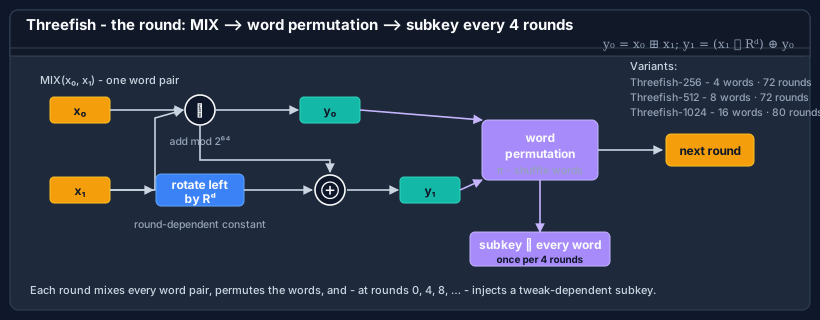
The 8-byte little-endian record ID fills the low half of the 16-byte tweak; the high half stays zero, leaving room to encode a second discriminator (a table ID, a tenant ID) if you need it. Because the tweak is mixed into every round's subkey, two records with different IDs are cryptographically unrelated even under the same key and IV - see Threefish-256 for the mechanism.
Why 512 is the general-purpose pick
Of the three Threefish variants, Threefish-512 is the one used as the core of the standard Skein-512 hash (Skein512) and is the recommended general-purpose choice:
- Its 64-byte block is wide enough to keep CBC's birthday bound irrelevant and large enough to amortise per-block overhead, yet its key schedule is far cheaper than Threefish-1024's.
- Throughput is roughly double Threefish-1024 on the same CPU for the same data.
- Padding waste rounds up to 64 bytes rather than 128 - material when records are a few hundred bytes.
Choose Threefish-256 when ciphertext size on short messages matters most, and Threefish-1024 only when you specifically want the widest block.
The raw primitive is Threefish512Cipher, an IBlockCipher taking a 64-byte key and 16-byte tweak - use it for hand-composed pipelines (Composing primitives).
Where to go next
- Encryption basics - the Key/IV/Tweak lifecycle.
- Cipher block modes - CFB / OFB / ECB also work with
Threefish512. - Padding - which padding scheme pairs with which mode.
- Other variants: Threefish-256, Threefish-1024.
- Hashing & Cryptography guides - every guide in this topic, across Bodu.IO.Hashing and Bodu.Security.Cryptography.