Using Threefish-1024
Threefish1024 is the largest variant in the Threefish family: 1024-bit (128-byte) blocks with a 1024-bit (128-byte) key and a 128-bit (16-byte) tweak. Reach for Threefish-1024 when you want the widest plausible block size - for example in domains that demand very large key/block margins, or where you want to encrypt a chunk that's naturally 128 bytes wide without chaining overhead per inner field.
Note
Encrypt/decrypt ships an AVX-512 fast path that engages automatically on supporting hardware. See Hardware acceleration & SIMD opt-out for when it runs and how to force the scalar path.
Fixed sizes at a glance
| Parameter | Size | Notes |
|---|---|---|
| Block size | 1024 bits (128 bytes) | Ciphertext is a multiple of 128 bytes (except in stream modes). |
| Key size | 1024 bits (128 bytes) | Fixed. |
| Tweak size | 128 bits (16 bytes) | Fixed across the Threefish family. |
| IV size | 1024 bits (128 bytes) | Always matches the block size. |
Encrypt and decrypt - CBC + PKCS7
using System.Diagnostics;
using System.Linq;
using System.Security.Cryptography;
using System.Text;
using Bodu.Security.Cryptography;
using Bodu.Security.Cryptography.Extensions;

byte[] plaintext = Encoding.UTF8.GetBytes("a substantial payload that benefits from a 128-byte block");

byte[] key, iv, tweak, ciphertext;
using (var alg = new Threefish1024 { BlockMode = CipherModeKind.CBC, Padding = PaddingMode.PKCS7 })
{
    alg.GenerateKey();
    alg.GenerateIV();
    alg.GenerateTweak();

    key   = alg.Key;     // 128 bytes
    iv    = alg.IV;      // 128 bytes
    tweak = alg.Tweak;   // 16 bytes

    ciphertext = alg.Encrypt(plaintext);
}

byte[] recovered;
using (var alg = new Threefish1024 { BlockMode = CipherModeKind.CBC, Padding = PaddingMode.PKCS7,
                                      Key = key, IV = iv, Tweak = tweak })
{
    recovered = alg.Decrypt(ciphertext);
}

Debug.Assert(plaintext.SequenceEqual(recovered));
Encrypt and decrypt - CTR (stream mode)
using var alg = new Threefish1024
{
    BlockMode = CipherModeKind.CTR,
    Padding   = PaddingMode.None,
};
alg.GenerateKey();
alg.GenerateIV();
alg.GenerateTweak();

byte[] ciphertext = alg.Encrypt(plaintext);
byte[] recovered  = alg.Decrypt(ciphertext);

Debug.Assert(plaintext.SequenceEqual(recovered));
Trade-offs worth knowing
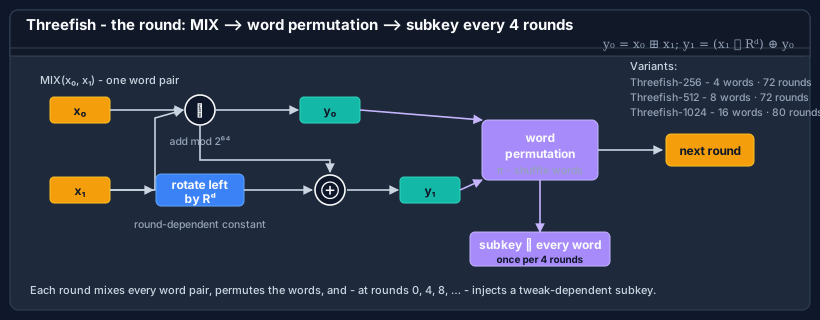
- Most rounds in the family. Threefish-1024 runs 80 rounds over sixteen 64-bit words, injecting a subkey every four rounds plus a final injection - 21 subkeys in all. That is the largest key schedule of the family and therefore the largest per-instance memory footprint. Throughput is roughly half of Threefish-512 on the same CPU.
- Padding waste. A PKCS7 round-up to the next 128-byte boundary costs more than the 32-byte Threefish-256 round-up. If your plaintexts are short, Threefish-256 produces smaller ciphertexts.
- Same 128-bit tweak. The tweak does not scale with the block - it is 16 bytes here exactly as in Threefish-256/512, so the per-context domain-separation pattern (Threefish-256) carries over unchanged.
- When to prefer it. When your natural record size is already ≥ 128 bytes, when you want a single-block encryption of a large structured field, or when you want the widest defensive margin against future block-size attacks. For everyday use Threefish-512 is the better balance.
The raw primitive
Threefish1024Cipher is the underlying IBlockCipher - a 128-byte key and 16-byte tweak in its constructor, one 128-byte block per Encrypt / Decrypt call. Use it for hand-composed pipelines; see Composing primitives. Like the rest of the family its 128-byte block is far too wide for the 128-bit-block AEAD transforms, so authenticate with encrypt-then-MAC or use the AES-based AEAD modes.
Where to go next
- Encryption basics - the Key/IV/Tweak lifecycle.
- Cipher block modes - CFB / OFB / ECB also work with
Threefish1024. - Padding - which padding scheme pairs with which mode.
- Composing primitives -
Threefish1024Cipher+ mode + padding by hand. - Other variants: Threefish-256, Threefish-512.
- Hashing & Cryptography guides - every guide in this topic, across Bodu.IO.Hashing and Bodu.Security.Cryptography.